
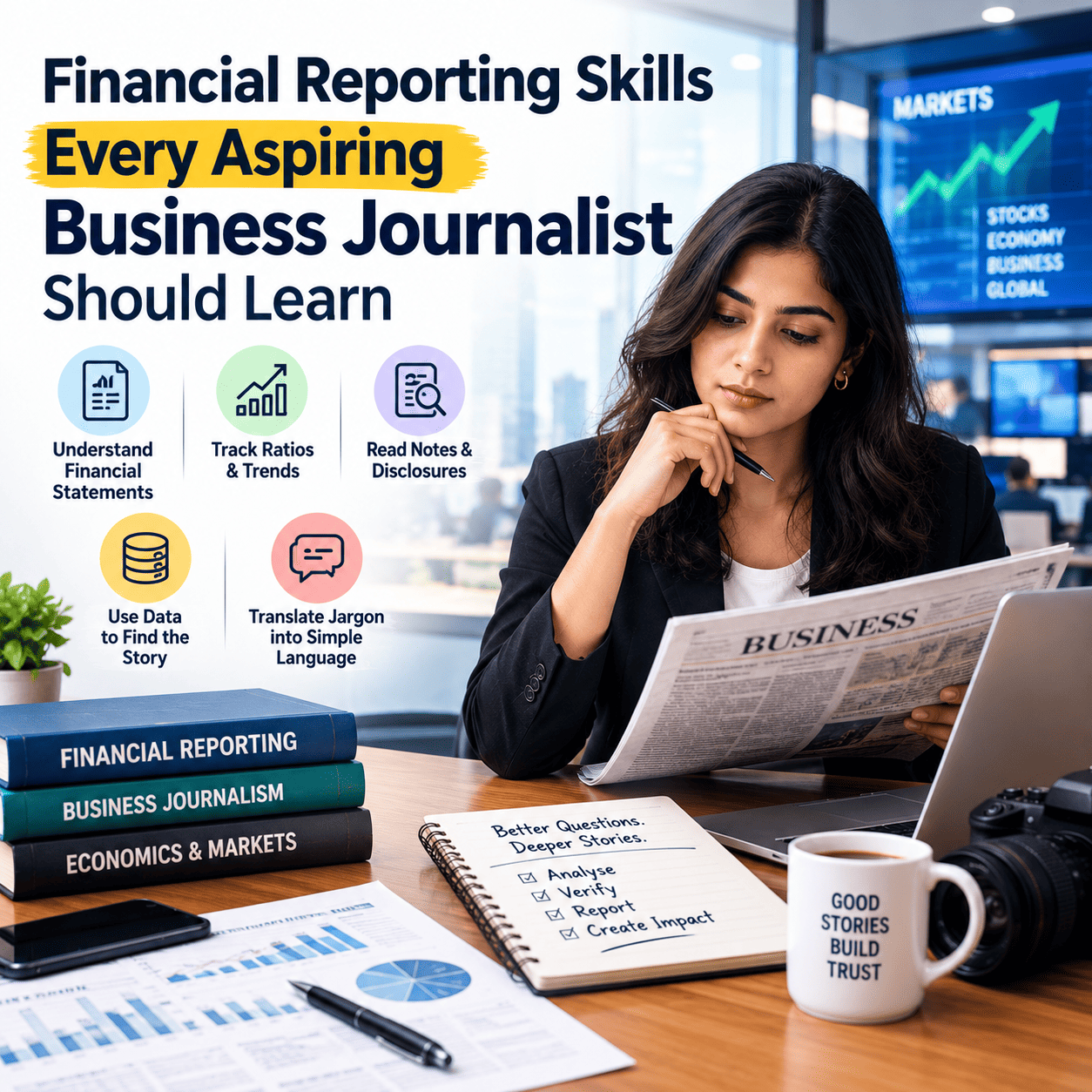
Financial Reporting Skills Every Aspiring Business Journalist Should Learn
Business journalism, part of financial journalism, is not only about interviewing executives or following stock-market updates. It is the ability to read numbers, question them, and explain them for every kind of audience: non-finance and finance viewers. For anyone planning a career in business media, developing financial reporting skills can help turn company disclosures, earnings announcements, and economic data into accurate, useful stories.
What Is Financial Reporting?
Financial reporting is the structured communication of a company’s financial performance and position through documents such as the income statement, balance sheet and cash flow statement. For journalists, these reports are valuable primary-source material. Corporate filings and financial results can help reporters verify claims, compare performance and identify developments worth investigating.
Did you know?
In India, journalists can use the National Stock Exchange’s Corporate Filings – Financial Results database to review reported numbers rather than relying only on company press releases.
Why Is Financial Knowledge Important for Business Journalists?
Financial knowledge helps journalists ask sourceful and in-depth questions of facts. A company may highlight strong revenue growth, but a reporter who understands margins, debt, cash flow, and exceptional items can examine whether the wider financial picture supports that narrative.
This is the sole reason why a financial reporting course or structured financial journalism training can be useful for aspiring reporters. \financial literacy supports more accurate interpretation, clearer interviews, and stronger explanations for readers who may not have a financial background.
Five Financial Reporting Skills Journalists Should Develop
1. Read the Three Core Financial Statements
Learn how the income statement, balance sheet, and cash flow statement connect. Revenue growth may look impressive, for example, but weakening operating cash flow can raise questions that deserve further reporting.
2. Track Important Ratios and Trends
Business journalists should understand commonly used measures such as operating margin, debt-to-equity ratio, return on equity and free cash flow. Comparing these metrics over time can reveal changes that headline numbers alone may miss.
3. Read Notes and Disclosures Carefully
Important context often appears beyond the headline results. Accounting policies, contingent liabilities, related-party transactions and changes in estimates can all add depth to a financial story.
4. Use Data to Find the Story
Journalists increasingly work with spreadsheets, databases and digital tools to compare companies, track trends and identify anomalies. As financial markets become more data-driven, working confidently with structured and unstructured information is increasingly relevant. The Reynolds Center for Business Journalism provides practical resources for reporters covering business and the economy.
5. Translate Financial Jargon into Plain Language
Knowing finance is only half the job. A strong business journalist skills must explain concepts such as leverage, inflation, interest rates or derivatives in language that makes their relevance clear to readers.
How Can Aspiring Journalists Build These Skills?
Start by reading annual reports and quarterly results, following credible business publications, practising with spreadsheets and comparing management commentary with reported data. A business journalism course can also help bring finance, reporting, data analysis and journalistic ethics together in a structured learning path.
FinX Institute (formerly BSE Institute) offers the Executive Program in Financial Journalism for graduates, journalists, finance professionals and aspiring business reporters. The five-month program covers fundamentals of financial journalism, business and economic reporting, finance and financial markets, quantitative methods and research, press laws and ethics, and advanced coding and data journalism.
If you want to strengthen both your financial understanding and your ability to turn complex information into credible stories, explore the Executive Program in Financial Journalism at FinX Institute and take the next step towards a career in business and financial media.