Choosing the right course after Class 12 is an important decision, especially for students interested in banking, finance, and financial markets. While traditional commerce degrees provide a foundation in accounting and business, specialised programmes can help students explore specific career paths early.
Among the career options after 12th commerce, financial risk management is an area worth considering.
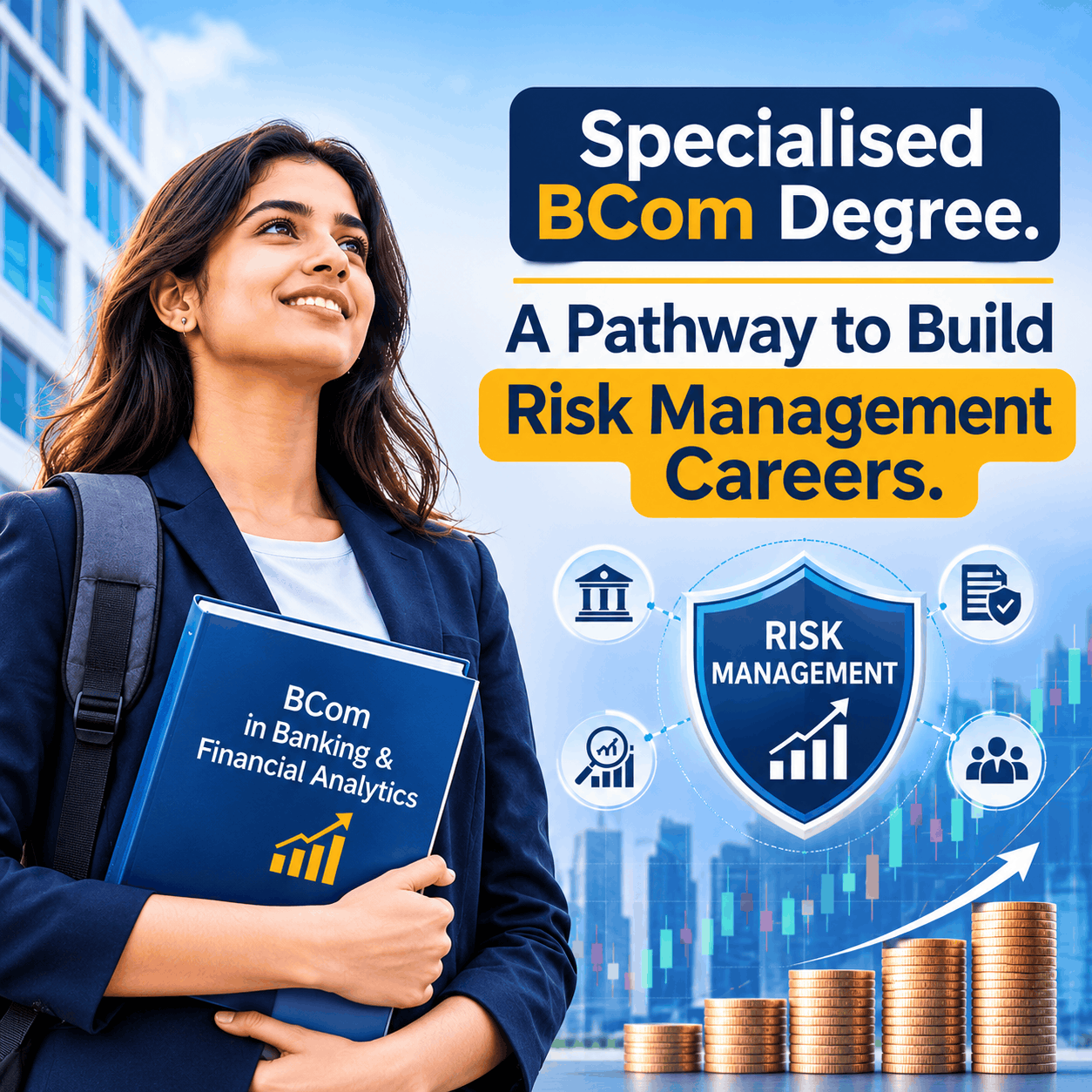
A BCom in Banking & Financial Analytics with a Risk Management specialisation, alongside a Financial Risk Manager (FRM) certification pathway, can provide a foundation for pursuing opportunities in this field.
Why Consider Risk Management as a Career After 12th Commerce?
Financial institutions face different forms of risk, including credit defaults, market fluctuations, liquidity challenges, and operational disruptions.
Regulatory frameworks developed by the Reserve Bank of India (RBI), Securities and Exchange Board of India (SEBI) and Insurance Regulatory and Development Authority of India (IRDAI) require financial institutions to assess and manage relevant risks.
This creates opportunities for professionals with financial knowledge, quantitative abilities and analytical skills.
For students comparing commerce career options, BCom with risk management offers opportunities across banking, consulting, financial technology and insurance.
What Is FRM Certification?
The Financial Risk Manager (FRM) certification is a globally recognised professional qualification administered by the Global Association of Risk Professionals (GARP).
It focuses on financial risk assessment, quantitative analysis, risk models and risk management practices.
According to GARP's official FRM certification requirements, candidates must:
- Pass FRM Part I.
- Pass FRM Part II within the prescribed four-year period.
- Submit two years of relevant full-time professional experience.
- Obtain approval of their experience to receive certification.
Candidates have up to ten years after passing Part II to submit their professional experience.
FRM Exam Structure, Subjects and Eligibility
The FRM examination consists of two computer-based parts.
| Particulars | FRM Part I | FRM Part II |
|---|---|---|
| Questions | 100 MCQs | 80 MCQs |
| Duration | 4 hours | 4 hours |
| Focus | Foundations and analytical concepts | Application of risk management techniques |
| Key subjects | Quantitative Analysis, Financial Markets and Products, Valuation and Risk Models | Market Risk, Credit Risk, Operational Risk, Liquidity and Treasury Risk, Risk and Investment Management |
| Exam windows | May, August, November | May, August, November |
Candidates can register through the official GARP FRM examination portal.
BCom in Banking & Financial Analytics: Building a Foundation for FRM
For students exploring the best course after 12 commerce, a specialised commerce degree can help develop the financial and analytical capabilities relevant to professional certifications.
The BCom in Banking & Financial Analytics offered by FinX Institute (formerly BSE Institute Ltd.) combines commerce fundamentals with banking, financial markets, and data analytics.
Its Risk Management specialisation connects academic learning with financial risk concepts.
Key Areas of Learning
- Banking and Financial Markets
- Financial Risk Analytics and Management
- Quantitative and Statistical Concepts
- Derivatives and Portfolio Management
- Financial Modelling
- Data Analytics
For more information, explore FinX Institute's BCom in Banking & Financial Analytics programme.
Career Options After BCom with an FRM Certification Pathway
Risk management includes several specialised career tracks.
The SME's research identifies six important roles:
| Career role | Key responsibilities |
|---|---|
| Credit Risk Analyst | Assess loan defaults, credit exposure and lending risks |
| Market Risk Analyst | Evaluate market fluctuations, exposure limits and potential losses |
| Operational Risk Professional | Assess operational controls, processes and business continuity |
| Model Validation Analyst | Review financial, statistical and risk models |
| Treasury and Asset-Liability Management Analyst | Monitor liquidity, interest-rate exposure and funding risks |
| Risk Consultant | Support financial institutions with risk frameworks, assessments and regulatory requirements |
These roles can require different levels of professional experience, statistical knowledge and technical expertise.
Which Companies Hire Financial Risk Management Professionals?
The SME's original research identifies opportunities across several categories of employers.
Global Banks and Financial Institutions
JPMorgan Chase, Goldman Sachs, Morgan Stanley, Deutsche Bank, Barclays, Citi and HSBC employ professionals across financial risk management functions.
Indian Banks and NBFCs
ICICI Bank, HDFC Bank, Axis Bank, Kotak Mahindra Bank and Bajaj Finance have functions covering credit, market, treasury and operational risk.
Consulting and Advisory Firms
Deloitte, EY, KPMG and PwC provide risk advisory, financial consulting and regulatory compliance services.
FinTech and Financial Services
Financial technology companies, credit-rating agencies, insurance organisations and asset management companies also employ professionals with relevant analytical and risk management capabilities.
FRM Salary Expectations and Career Progression in India
Salary expectations depend on experience, role, location, employer and technical capabilities.
The SME's research, drawing on recruiter and education-provider estimates, suggests that entry-level professionals pursuing FRM-related roles may encounter indicative salary ranges of ₹6-12 lakh per annum.
Professionals may progress through roles such as:
Risk Analyst → Senior Risk Analyst → Risk Manager → Vice President → Head of Risk → Chief Risk Officer
Progression depends on work experience, professional competence and organisational responsibilities.
For students exploring broader options, read FinX Institute's guide to courses after 12th commerce.
Build Your Future in Banking and Risk Management with FinX Institute
For students confused among many courses after 12th commerce, considering banking, quantitative analysis, and financial risk management, a specialised commerce degree offers an opportunity to build relevant skills early.
The BCom in Banking & Financial Analytics with a Risk Management specialisation at FinX Institute (formerly BSE Institute Ltd.) provides exposure to financial markets, banking operations, financial modelling, risk analytics and technology-driven finance.
Students interested in professional development can also explore how these academic foundations relate to the globally recognised FRM certification pathway.