
IT Cyber Security Training: Everything You Need to Know Before Starting Your Career (2026 Guide)
As digital transformation accelerates across industries, cyber security has become a critical priority for organizations worldwide. It has become one of the most important and fastest-growing career fields today. We live in a world where almost everything is connected to the internet: banking, retail, education, and even daily communication. While this makes life easier, it also increases the risk of cyber attacks.
For students and working professionals exploring this field, selecting the right IT cyber security training program is a crucial first step. With multiple options available, ranging from short-term certifications to comprehensive diploma programs - like certifications, short courses, and diplomas, it is important to understand which path aligns best with your career goals.
This guide will help you understand what to expect from a cyber security course, whether a certificate is enough, and how to choose the right training program for a successful career.
What Is a Certificate Course in Cyber Security?
A cyber security certification course is typically for a short-term duration, designed for beginners. It introduces you to the basics of cyber security and helps you understand how systems and data are protected from cyber threats.
Many students start with a cyber security course for beginners because it does not require deep technical knowledge. These courses are a good starting point if you want to explore the field before committing to a long-term program.
What Do Students Learn in a Cyber Security Certificate Course?
In a certificate course, you will learn the basic concepts of cyber security along with some level of cyber security practical training. Topics usually include:
- Introduction to cyber security and common threats
- Basics of ethical hacking training
- Network security fundamentals
- Password protection and data safety
- Introduction to SOC analyst training
- Basic tools used in cyber security
These courses are helpful to build your foundation, but they usually do not go very deep into advanced topics.
Is a Certificate Course Enough to Get a Cyber Security Job?
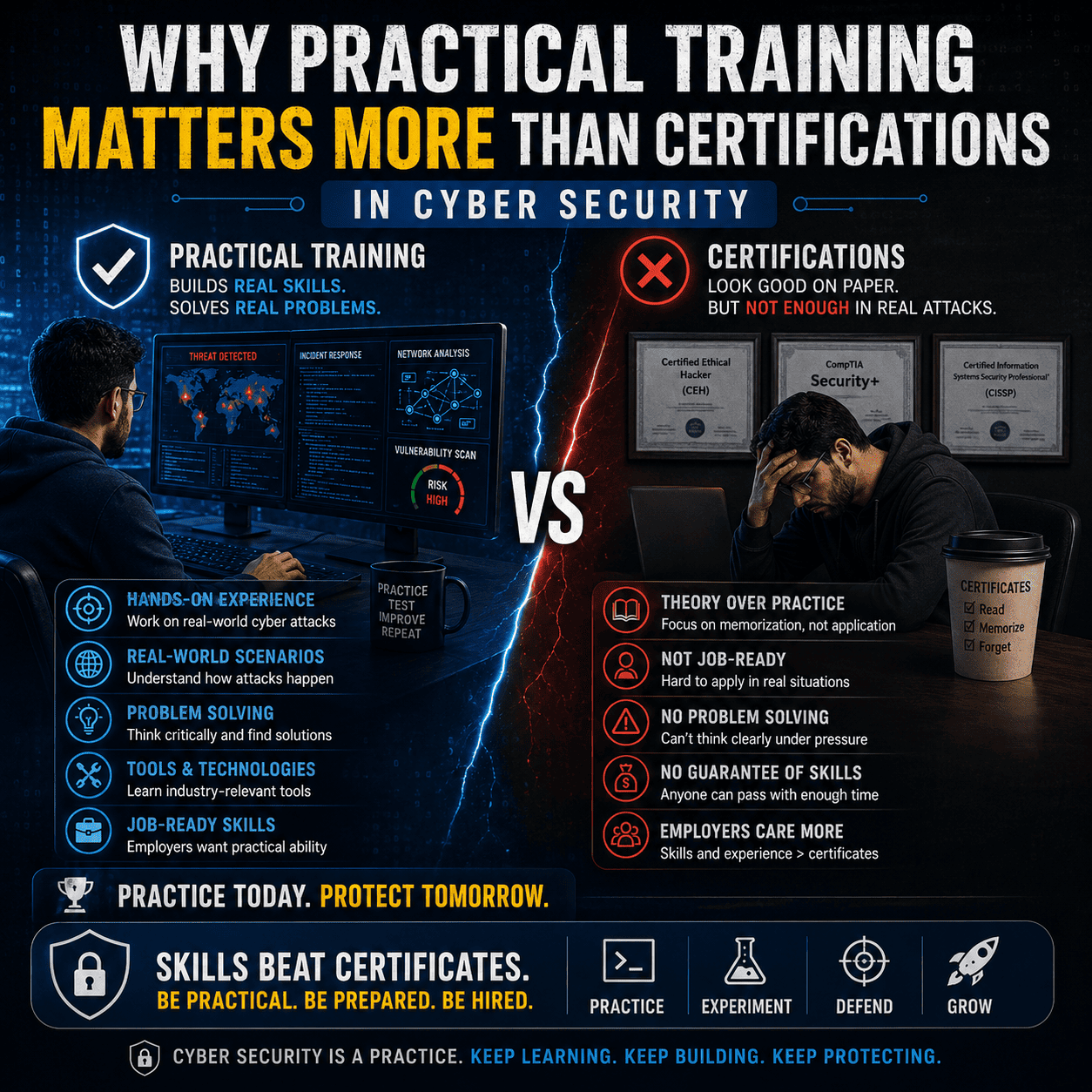
A certificate course can help you understand the basics, but it may not always be enough to secure a good job.
Today, companies look for candidates who have:
- Strong practical skills
- Hands-on experience with tools
- Real-world project knowledge
- Problem-solving ability
While a certification can help you get started, it may not be enough for roles like ethical hacker, SOC analyst, or security analyst. To get better opportunities in cyber security jobs in India, you usually need more advanced training.
Certificate Course vs PG Diploma in Cyber Security
When choosing between a certificate course and a PG Diploma in Cyber Security, the main difference is how deeply you learn the subject.
Certificate Course:
- Short duration
- Basic knowledge
- Limited practical exposure
- Good for beginners
PG Diploma in Cyber Security:
- Longer duration
- Advanced and detailed learning
- Strong focus on cyber security practical training
- Often includes cyber security training with placement
A diploma program prepares you for real job roles, while a certificate course mainly builds your base.
Which Course Is Better for Long-Term Career Growth?
If you want a long-term career in cyber security, a PG Diploma in Cyber Security is usually the better option.
It helps you:
- Learn advanced skills
- Gain practical experience
- Work on real-world case studies
- Become job-ready
Certificate courses are useful in the beginning, but they are often not enough for long-term growth in the industry. In fact, well-structured programmes—such as the PG Diploma in Cyber Security offered by FinX Institute (formerly BSE Institute)—are specifically designed to combine conceptual clarity with hands-on application. These programmes typically include modules on ethical hacking training, network security, cryptography, and cyber defence, ensuring that students are equipped to handle real-world challenges rather than just theoretical scenarios.
What Should You Look for in a Cyber Security Training Institute?
Before joining any course, make sure you choose the right institute. If you are looking for a cyber security course in Mumbai, here are some important points to check:
1. Practical Learning
Ensure the program prioritizes cyber security practical training alongside theoretical instruction.
2. Updated Curriculum
The course should include topics like ethical hacking training, SOC analyst training, and modern security tools.
3. Placement Support
Institutes offering cyber security training with placement can significantly enhance employability. For example, institutes like FinX Institute integrate career support and placement-oriented training within their diploma programmes, helping students transition more effectively into professional roles.
4. Industry Experts
Learning from experienced professionals gives you better real-world knowledge and exposure to current trends.
5. Reputation
A reputed cyber security institute Mumbai with strong infrastructure and industry connections can provide better learning and career opportunities.
Career Opportunities After Learning Cyber Security
After completing your training, you can explore different roles in the cyber security field. Some popular career options include:
- SOC Analyst
- Cyber Security Analyst
- Ethical Hacker
- Network Security Engineer
- Information Security Analyst
With increasing digital adoption, the demand for skilled professionals continues to rise, making cyber security jobs in India highly promising.
Professionals trained through comprehensive diploma programmes, such as those offered by FinX Institute, often have an added advantage due to their exposure to real-world tools, simulations, and structured training, which are critical for these roles.
Why Many Students Choose a PG Diploma in Cyber Security Instead of Only a Certificate
A growing number of students prefer enrolling in a PG Diploma in Cyber Security rather than relying solely on a certification. This shift is driven by the need for deeper technical knowledge and stronger career outcomes.
A PG Diploma in Cyber Security offers:
- Better job opportunities
- Higher salary potential
- Hands-on training
- Real-world project experience
- Placement support
Industry-focused programmes emphasize real-world application, ensuring that students are not only qualified but also confident in handling live cyber security scenarios.
Conclusion
Cyber security is one of the most promising career fields today. Starting with a cyber security certification or a cyber security course for beginners is a good first step, but it may not be enough for long-term success.
To build a strong career, you should focus on complete IT cyber security training that includes practical learning and real-world exposure.
If you are serious about entering this field, consider enrolling in a PG Diploma in Cyber Security from a trusted cyber security institute Mumbai that offers cyber security training with placement.
For individuals serious about entering this field, pursuing a PG Diploma in Cyber Security from a reputed cyber security institute Mumbai, such as FinX Institute (Formerly, BSE Institute), can significantly improve career prospects, especially when combined with cyber security training with placement.
Making the right educational choice today can set the foundation for a successful and future-ready career in cyber security.
Ready to Explore?
Check out the PG Diploma in Cyber Security at FinX Institute — taught by 300+ industry practitioners with deep BFSI networks and a 35+ year legacy.