
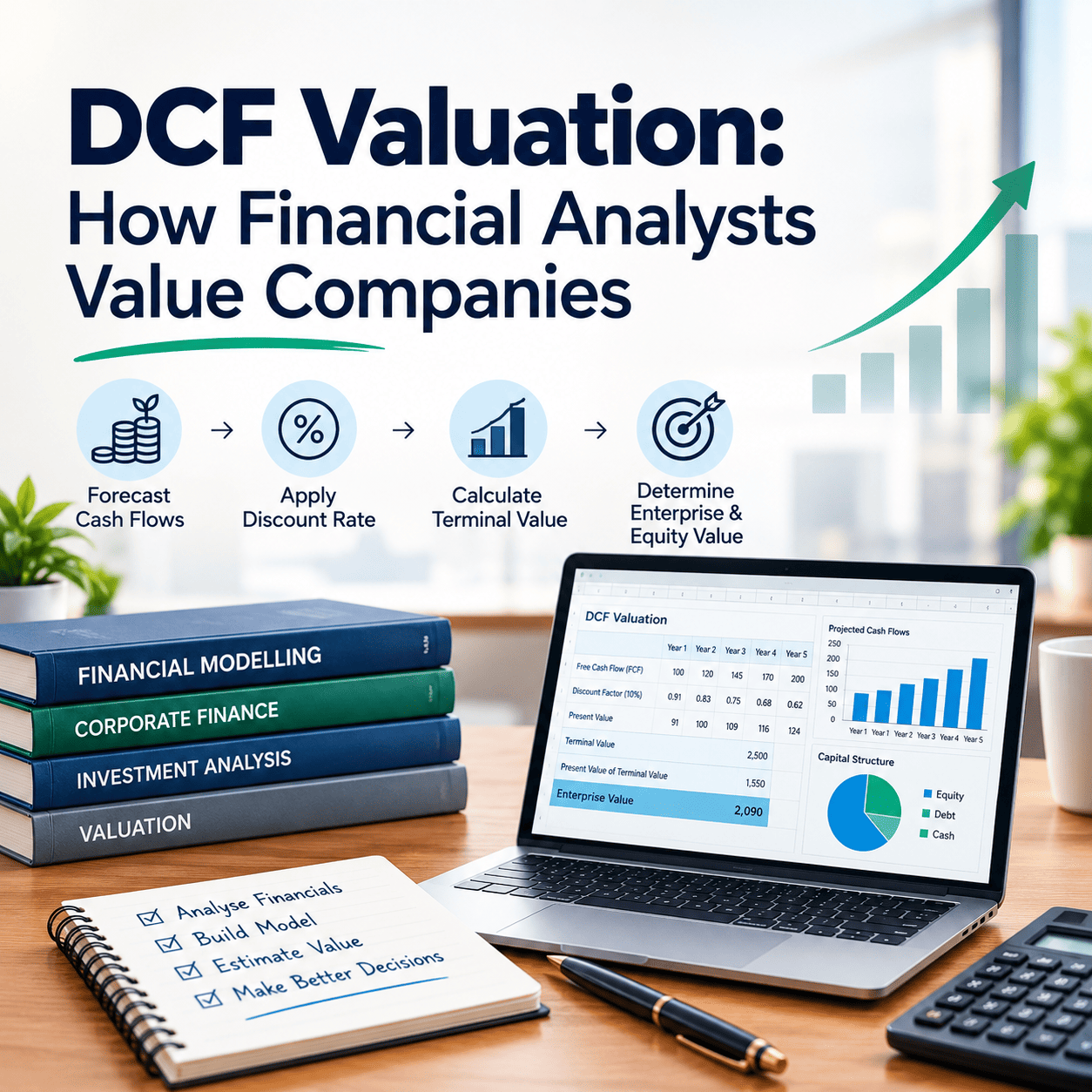
DCF Valuation: How Financial Analysts Value Companies
How do financial analysts decide what a company may actually be worth?
One of the most widely used approaches is Discounted Cash Flow (DCF) valuation. Rather than relying only on current market price, DCF valuation estimates value based on the cash flows it is expected to generate in the future.
For students and professionals considering a DCF valuation course, understanding this method is important because DCF combines financial statement analysis, forecasting, valuation, and business judgment skills commonly used in equity research, investment analysis, and corporate finance.
What Is DCF Valuation?
DCF valuation, or discounted cash flow valuation, is an intrinsic valuation method.
The basic idea is straightforward: money expected in the future is worth less than the same amount today. Analysts therefore forecast future cash flows and discount them back to their present value using a rate that reflects risk and the time value of money.
A simplified DCF formula can be expressed as:
Present Value = Future Cash Flow ÷ (1 + Discount Rate)n
However, building a reliable DCF model requires much more than applying a formula.
1. Forecast Future Free Cash Flows
The first step in using DCF is to understand how the business operates.
Analysts examine historical revenue, operating expenses, profit margins, taxes, capital expenditure, and working-capital requirements before forecasting future performance.
Two commonly used cash-flow measures are:
- Free Cash Flow to the Firm (FCFF): Cash available to both debt and equity capital providers.
- Free Cash Flow to Equity (FCFE): Cash available to equity shareholders after accounting for financing requirements.
2. Select an Appropriate Discount Rate
Future cash flows must then be converted into today's value.
When analysts use FCFF, they generally discount those cash flows using the Weighted Average Cost of Capital (WACC). WACC reflects the required returns of both equity investors and lenders based on the company's capital structure.
When valuing equity directly using FCFE, analysts typically use the required return on equity.
3. Calculate the Terminal Value
Analysts cannot reasonably forecast individual cash flows forever.
A DCF model therefore normally includes a terminal value, which represents the estimated value of cash flows occurring after the explicit forecast period.
Common approaches include:
- Perpetual Growth Method: Assumes cash flows continue growing at a sustainable long-term rate.
- Exit Multiple Method: Estimates terminal value using a market-based valuation multiple, such as EV/EBITDA.
Because terminal value can represent a significant part of the overall valuation, assumptions regarding long-term growth and discount rates require careful consideration.
4. Calculate Enterprise and Equity Value
Once forecast cash flows and the terminal value are discounted to present value, you can estimate the company's enterprise value.
When using an FCFF model, the analyst then adjusts enterprise value for items such as debt and cash to arrive at equity value.
The resulting equity value can be divided by the appropriate number of shares to estimate an implied value per share.
This intrinsic value can then be compared with the current market price as part of a broader investment analysis.
These calculations are central to company valuation and help analysts evaluate a business based on its expected financial performance.
Why Is DCF Important for Financial Analysts?
DCF forces analysts to examine what actually drives a company's value.
Instead of simply assuming that a stock is cheap or expensive because of its market price, analysts need to assess factors such as:
- Revenue growth
- Profit margins
- Capital expenditure
- Working capital
- Business risk
- Cost of capital
- Long-term growth potential
This is closely connected with financial modelling and fundamental analysis.
Learners exploring roles where these skills may be relevant can also read FinX Institute's guide on 10 career paths after a BSc in Finance, which covers career options across financial analysis, investment banking, corporate finance, and related areas.
Learn DCF and Financial Modelling with FinX Institute
The Equity & Financial Modelling (EFM) program at FinX Institute helps learners strengthen practical skills across financial statement analysis, fundamental analysis, financial modelling, forecasting, equity valuation, Excel, and Discounted Cash Flow valuation.
For students and professionals looking to build capabilities in equity research, investment analysis, corporate finance, and financial modelling, learning to interpret DCF models can be a valuable addition to their finance skill set.
Build the skills to analyse businesses beyond their market price.
Explore the EFM program to develop practical skills in equity valuation, financial modelling, forecasting, and business analysis.