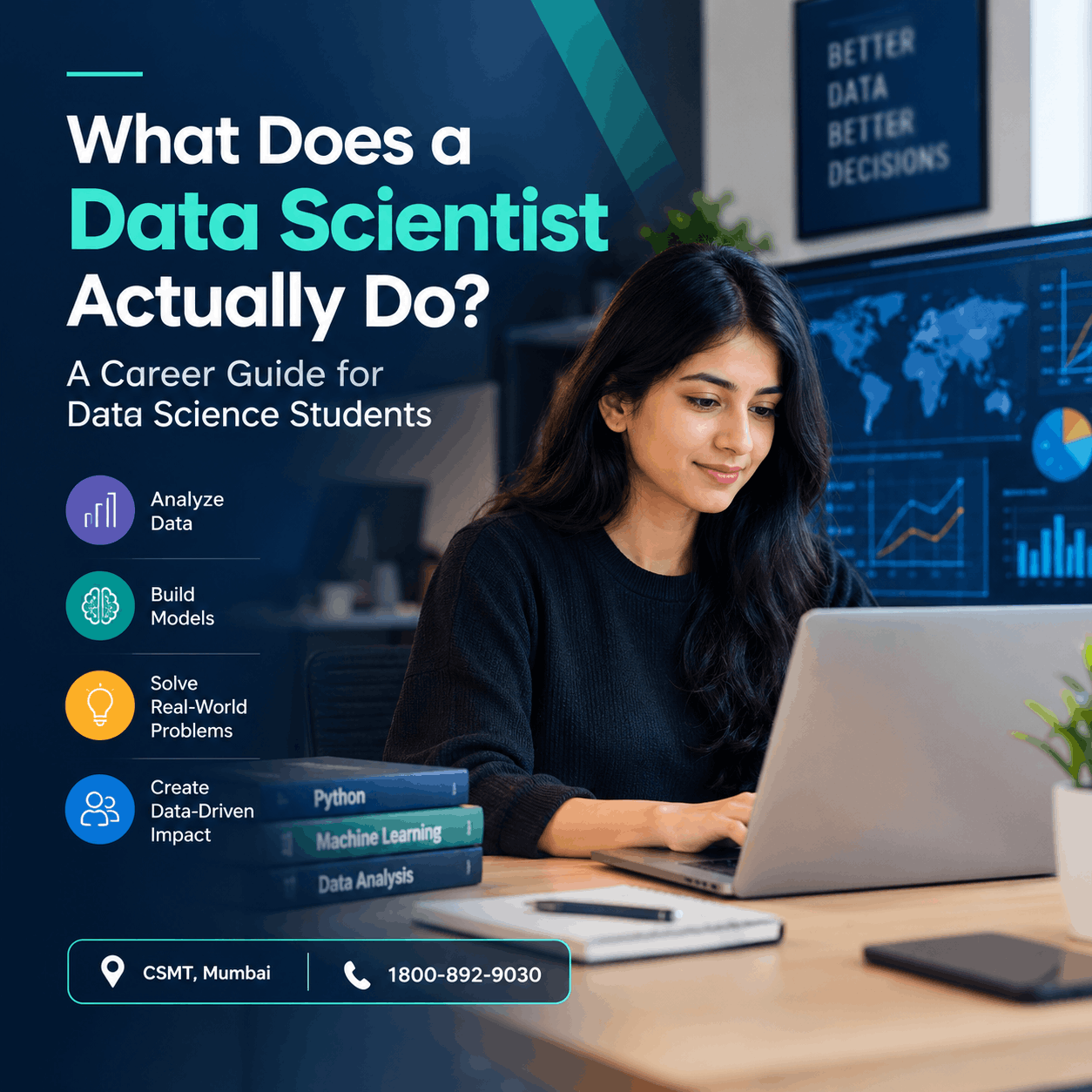
What Does a Data Scientist Actually Do? A Career Guide for Data Science Students
Data is changing how organisations make decisions. From banking and healthcare to retail, technology, finance, and e-commerce, businesses increasingly rely on data to understand customers, improve operations, manage risk, and identify new opportunities.
This has increased the need for professionals who can analyse information and turn it into useful insights. One of the key roles in this field is that of a data scientist.
For students considering BSc Data Science after 12th, understanding what a data scientist actually does, the skills required, potential salaries, and the educational pathway can help them make a more informed career decision.
What Does a Data Scientist Do Daily?
The responsibilities of a data scientist can vary depending on the organisation and industry. However, a typical workflow may involve:
Collecting data: Gathering information from databases, applications, surveys, websites, business systems, or other sources.
Cleaning data: Identifying missing values, inconsistencies, duplicates, and incorrect information before analysis.
Analysing data: Using statistical techniques and programming tools to discover trends and relationships.
Building models: Applying machine learning or statistical models to predict outcomes.
Visualising insights: Creating dashboards, charts, and reports that make complex information easier to understand.
Communicating findings: Explaining results to business teams and helping decision-makers understand their implications.
Data scientists therefore combine technical knowledge with an understanding of business problems.
Skills Required to Become a Data Scientist
Successful data scientists combine technical expertise with analytical thinking, business understanding, and communication skills.
Some of the most important skills include:
- Python and R
- SQL and Database Management
- Statistics
- Data Visualisation
- Machine Learning
- Problem-Solving and Communication
Tools such as Power BI and Tableau are commonly used to present data through dashboards and reports. Programming languages such as Python and R help professionals analyse information, while SQL is important for working with databases.
Strong communication skills are equally important because data scientists often need to explain complex findings to people without technical backgrounds.
Data Scientist Salary in India
Data science offers competitive career opportunities, though salaries vary based on experience, skills, employer, industry, and location.
According to Coursera's India career guide, data scientists in India earned an average annual salary of approximately ₹11.5 lakh, based on July 2025 data.
Possible career paths can include:
- Data Scientist
- Data Analyst
- Business Intelligence Analyst
- Machine Learning Engineer
- Data Engineer
- Analytics Consultant
- AI and Machine Learning Specialist
- Senior Data Scientist
How to Become a Data Scientist After 12th
Students interested in becoming data scientists can begin building the necessary foundation immediately after completing Class 12.
A typical learning pathway can include the following steps.
- Build Mathematical and Statistical Foundations
- Learn SQL and Databases
- Learn Data Visualisation
- Understand Machine Learning
- Work on Real Projects
Studying Data Science After Class 12
Students interested in technology, analytics, artificial intelligence, and problem-solving can consider pursuing a structured undergraduate programme in data science.
The BSc in Data Science offered by FinX Institute, formerly BSE Institute Ltd., in collaboration with Homi Bhabha State University, introduces students to areas such as programming, statistics, databases, data visualisation, and machine learning.
Graduates can explore opportunities across banking and financial services, technology, consulting, healthcare, retail, FinTech, e-commerce, insurance, and other data-driven industries.
Start Your Data Science Journey.
Becoming a data scientist is not only about learning software tools. It involves understanding problems, analysing information, identifying patterns, and communicating insights effectively.
Students interested in building a career around data and technology can explore the BSc in Data Science at FinX Institute to learn more about the curriculum, eligibility, learning outcomes, and admission process.