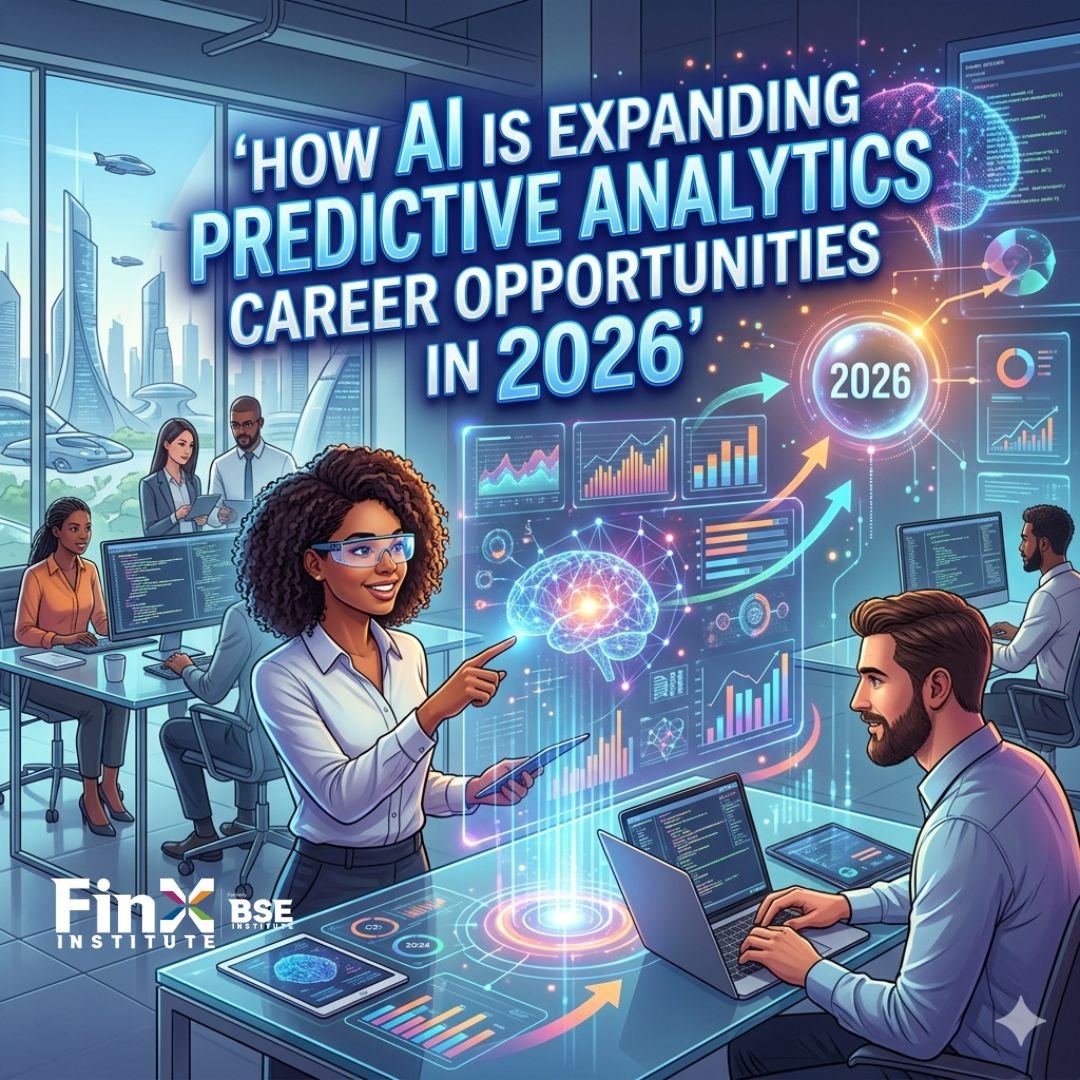
How AI Is Expanding Predictive Analytics Career Opportunities in 2026
Something structural happened to predictive analytics in the last two years. It stopped being a tool that data teams used and became something closer to an operating system that the entire organisation runs on. Artificial intelligence is the reason, and the effect on careers has been dramatic.
The roles available in predictive analytics in 2026 look fundamentally different from the ones that existed in 2022. Some have been elevated. A handful have been automated away. Entirely new jobs that didn't even exist five years ago now appear in every major hiring market. And the salary gap between professionals who understand AI-integrated analytics and those who don't has widened to a point where it cannot be ignored.
This analysis breaks down exactly what AI has changed, what careers it has created, what skills now separate competitive candidates from everyone else, and why 2026 is a pivotal moment for anyone considering a career in this space.
The Role of AI in Modern Predictive Analytics
Predictive analytics, at its core, has always been about using historical data to forecast future outcomes. What AI — specifically machine learning, deep learning, and large language models — has done is change the ceiling on what forecasting can achieve.
Traditional predictive analytics required human analysts to decide which variables mattered, which model to use, and when to retrain. Every update was a manual project. The model was accurate within bounded conditions but degraded quickly when the world changed — as it did, abruptly, in 2020, 2022, and 2023.
AI-powered predictive analytics is different in kind, not just degree. Here is what has changed across every dimension of the discipline:
| Dimension | Traditional Predictive Analytics | AI-Powered Predictive Analytics |
|---|---|---|
| Data Inputs | Structured data only (spreadsheets, databases) | Structured + unstructured (text, images, social signals, IoT feeds) |
| Model Updates | Batch retraining — weekly or monthly | Continuous learning — updates in near real-time |
| Accuracy | Moderate — degrades as conditions shift | High and adaptive — self-corrects for new patterns |
| Human Role | Analysts build and interpret every model | Analysts govern, validate, and translate model outputs |
| Speed | Hours to days for a full analysis cycle | Minutes to seconds with automated pipelines |
| Scope | Single-domain models (e.g. sales forecasting) | Cross-domain intelligence (risk + sentiment + demand combined) |
| Scale | Thousands of data points | Billions of data points processed continuously |
Why This Shift Is Irreversible
The shift from traditional to AI-powered predictive analytics is definitive — once a financial firm has implemented a real-time credit risk model, reverting to monthly updates is no longer viable. Similarly, a retail chain that integrates weather and social sentiment into its demand forecasts will find spreadsheet methods inadequate.
Demand for AI in predictive analytics careers is increasing at 30% yearly in India, according to Analytixlabs' AI Skills Playbook 2026. In contrast, legacy roles and basic BI are experiencing oversupply and decreasing interest. The market is clearly moving in one direction.
Emerging Job Roles Powered by AI
The predictive analytics job market has not simply grown — it has reorganised. Peripheral roles are now central. Optional capabilities are now minimum requirements. And a new tier of hybrid roles — part data scientist, part product manager, part strategist — has emerged as the highest-compensated layer of the analytics profession.
Here are the key emerging roles defining the AI-driven predictive analytics career landscape in 2026:
| Role | What They Do | India Salary Range | Who's Hiring |
|---|---|---|---|
| AI Analytics Engineer | Builds automated ML pipelines that feed live business dashboards | ₹8–18 LPA | Fintech, e-commerce, BFSI |
| MLOps / LLMOps Engineer | Deploys and governs predictive models in production environments | ₹10–22 LPA | Tech firms, MNCs, GCCs |
| AI Product Manager | Bridges business strategy and AI capability — defines what gets built | ₹12–25 LPA | Product companies, SaaS |
| Responsible AI Specialist | Ensures model fairness, explainability, bias detection, and compliance | ₹9–20 LPA | Banking, insurance, consulting |
| GenAI Data Scientist | Applies large language models to analytics, reporting, and forecasting | ₹10–25 LPA | All sectors, especially BFSI |
| Quantitative AI Analyst | Builds AI-enhanced risk, trading, and valuation models for finance | ₹8–20 LPA | Capital markets, hedge funds |
| NLP / Text Analytics Lead | Extracts insights from contracts, filings, news, and customer feedback | ₹8–18 LPA | BFSI, legal tech, e-commerce |
| Forecasting & Strategy Analyst | Translates AI-generated predictions into executive-level business plans | ₹6–14 LPA | Consulting, logistics, retail |
The Roles That Have Been Elevated (Not Replaced)
A common concern among students and early-career professionals is whether AI will eliminate analytics jobs. However, evidence suggests the opposite: AI is reducing low-skill analytics tasks while enhancing opportunities for skilled professionals.
Roles focused on data collection and basic reporting are under threat, but positions requiring critical judgment, model selection, and translating statistical insights are growing and offer higher pay.
An analysis of over 700 job postings by Data Science Collective revealed that roles referencing Generative AI consistently offer higher salaries compared to non-GenAI positions — indicating a structural shift in skill expectations for senior analytics professionals.
Skills Required for AI-Driven Analytics Careers
If there is a single question that matters most to anyone considering a predictive analytics career in 2026, it is this: what do I actually need to know? The answer has changed meaningfully in the last 24 months — and getting it right is the difference between landing the roles that are growing and ending up competing for the ones that are stagnating.
| Skill Layer | Specific Competencies | Why It Matters in 2026 |
|---|---|---|
| Statistical Reasoning | Probability, regression, hypothesis testing, Bayesian inference | The mathematical foundation that keeps AI outputs interpretable and trustworthy |
| Programming | Python (primary), R, SQL — plus APIs for LLM integration | Production AI roles require hands-on coding, not just tool operation |
| Machine Learning | Supervised/unsupervised learning, ensemble methods, deep learning, transformers | Core model-building skills — the engine of every AI-powered analytics product |
| MLOps | Model versioning, CI/CD pipelines, monitoring, deployment (AWS, Azure, GCP) | Bridges the gap from prototype to production — top skill gap cited by hiring managers |
| Explainability & Ethics | SHAP values, LIME, AI governance frameworks, regulatory compliance | Regulators and boards increasingly require auditable, explainable model decisions |
| Domain Knowledge | Finance, risk, healthcare, or supply chain — choose a sector to specialize in | Domain context turns a competent analyst into a strategic, highly compensated advisor |
| Communication | Storytelling with data, dashboard design, executive presentations, stakeholder framing | Technical skill without communication is invisible — the rarest and most valued combination |
The Skills That Hiring Managers Say Are Hardest to Find
The Analytixlabs AI Skills Playbook 2026 surveyed hiring managers across India's major analytics employers and identified three acute shortage areas:
The Certification Landscape in 2026
Formal certifications have become a meaningful signal in AI and predictive analytics hiring — not because they replace skills, but because they provide standardised proof of them. The most valued credentials in 2026 are:
- AWS Certified Machine Learning
- Google Professional Data Engineer / Google Advanced Data Analytics
- CFA — for finance-focused analysts
- NISM Certifications — India-specific
- deeplearning.ai Specializations (Coursera)
Why 2026 Is a Turning Point for Predictive Analytics Careers
Several discrete forces have converged in 2026 to make this a distinctly important moment for anyone building or repositioning a career in predictive analytics. None of these is speculative — they are observable market conditions with direct career consequences.
1. The Pilot Phase Is Over
In 2026, the pilot phase for AI in predictive analytics is over for India's major financial institutions, e-commerce platforms, and tech companies. AI systems are now live, requiring professional staff to operate, govern, and improve them. This shift from experimentation to operation drives sustained hiring — the demand for AI analytics professionals is now essential for operations rather than driven by novelty.
2. Generative AI Has Created a New Skills Premium
The arrival of production-grade large language models has opened a new compensation tier in predictive analytics. Senior LLM and GenAI specialists at Tier-1 firms are seeing median salaries in the ₹28–32 LPA range — a band that simply did not exist in the analytics profession 36 months ago. Prompt engineering, LLM fine-tuning, and GenAI integration with traditional predictive pipelines are the skills that hiring managers cite as most urgently needed and least available. For professionals who acquire them now, the compensation premium is significant and the competitive landscape is still relatively uncrowded.
3. AI Has Become an Entry Requirement, Not an Advantage
AI fluency has shifted from a 'nice to have' to a 'minimum viable qualification' for entry-level predictive analytics roles at competitive firms. Fast-growing positions like ML Engineer and AI Analytics Engineer require AI skills, while declining roles such as SQL-only analyst and basic BI developer lack AI integration. Professionals entering the field in 2026 need AI-focused training as a baseline — programs that ignore genuine AI depth risk preparing students for a shrinking job market.
Conclusion: What This Means for You
The integration of AI into predictive analytics is an expansion rather than a disruption — increasing the career opportunities in the data field. Success will favour professionals who grasp the entire process from data infrastructure to model deployment and business translation, especially within specific domains.
As you consider advancing your career in AI-powered predictive analytics, prioritise foundational training that combines technical depth, domain-specific application, and practical experience. Institutions that emphasise these elements will better position their graduates to seize opportunities in 2026 and beyond.
FinX Institute (Formerly BSE Institute Ltd) has been training India's finance and analytics professionals with its 35+ years of legacy. Its PG Diploma in Predictive Analytics and BSc Data Science programs are built specifically to close the skill gaps this analysis describes: AI-integrated curriculum, 300+ industry practitioner faculty, live market data exposure, and placement support with top BFSI and analytics recruiters.
Explore the PG Diploma in Predictive Analytics and BSc Data Science at FinX Institute (formerly BSE Institute).
Call: 1800 892 9030 · Email: finxinstitute.training@finxpert.org · finxinstitute.com