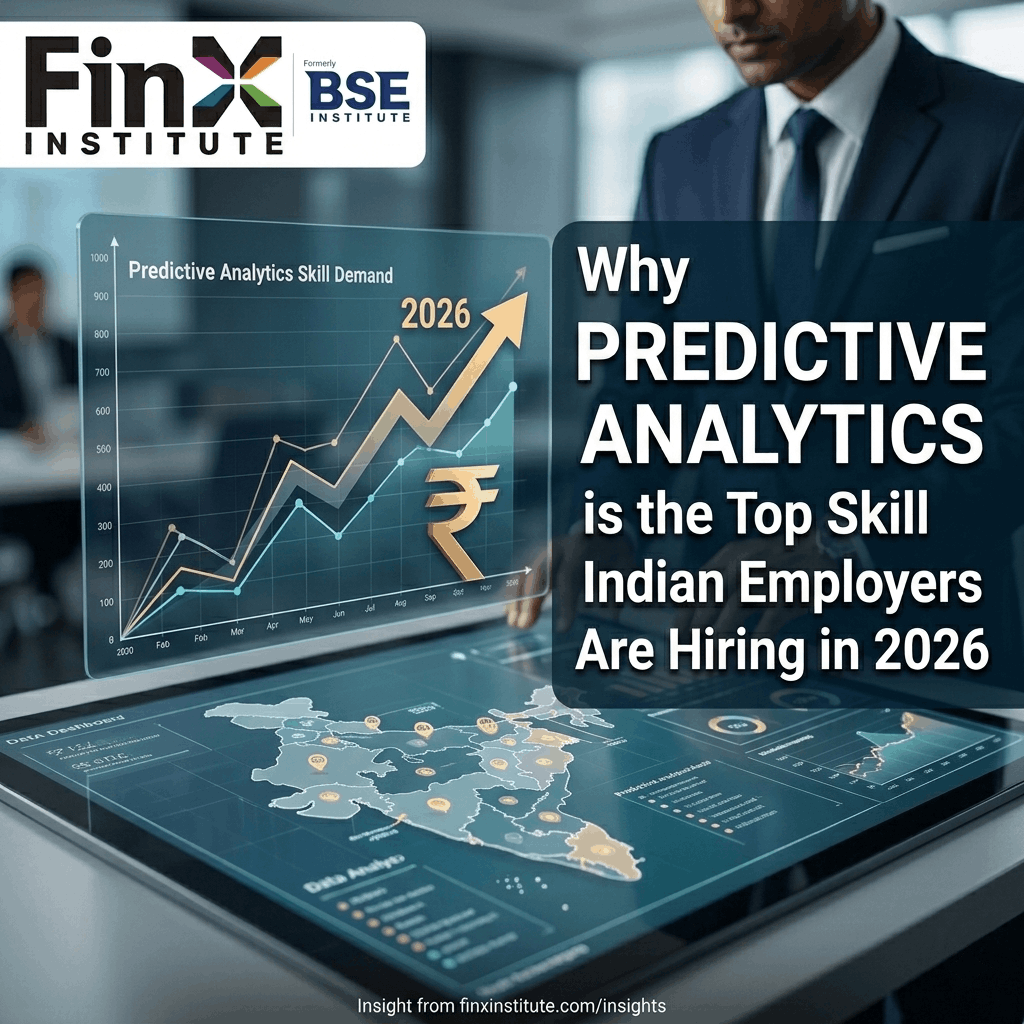
Why Predictive Analytics Is the Top Skill
Indian Employers Are Hiring in 2026
AI Trends & the ₹6,800 Crore Market Opportunity Reshaping India's Analytics Careers
Predictive Analytics is not an emerging skill in 2026. It is on the must-have list. Across India's BFSI, e-commerce, healthcare, and manufacturing sectors, hiring managers are no longer asking whether a candidate knows data science. They are asking whether a candidate can build models that run in production, handle real-time data streams, deploy on cloud platforms, and generate outputs that an executive can act on within seconds.
The shift from 'nice to have analytics experience' to 'must have production-ready predictive skills' is the defining hiring story of 2026. This analysis unpacks every dimension of that opportunity: the market size, the technologies reshaping the field, the sectors with the most acute talent need, the roles being created by agentic AI, where the jobs actually are, and how FinX Institute's Post Graduate Diploma in Predictive Analytics (PGDPA) is built to place graduates precisely where that demand is concentrated.
India's Predictive Analytics Market Hits $1.12 Billion in 2026 — What This Means for Fresh Graduates
India's predictive analytics market is projected to reach $1.12 billion (approximately ₹9,300 crore) in 2026, growing at a CAGR of 23–25% — one of the fastest expansion rates of any technology sub-sector in the country. Within the broader ₹6,800 crore analytics services market, predictive analytics is the highest-growth segment because it directly drives revenue, reduces costs, and manages risk for companies that invest in it.
| Sector | Predictive Analytics Use Case | Market Size / Hiring Signal 2026 |
|---|---|---|
| Telecom & Media | Customer lifetime value models, network failure prediction, and content recommendation AI | ₹500+ crore; Jio, Airtel, Zee Media building in-house PA centres |
| Government & Smart Cities | Urban traffic prediction, public health surveillance, tax fraud analytics | Growing — Smart City Mission + NITI Aayog AI for governance initiatives |
| BFSI | UPI fraud detection, credit risk scoring, AML compliance, customer churn models | ₹91T sector; 8.7% hiring growth FY25–26; 42% AI skill gap in GCCs |
| Healthcare | Hospital readmission prediction, diagnostic AI, clinical outcome forecasting | 700+ metro hospitals using AI tools; National Health Stack driving rural adoption |
| E-commerce & Retail | Demand forecasting, personalised recommendations, supply chain optimisation | India e-commerce projected at $200B by 2026; Amazon, Flipkart scaling PA teams |
Real-Time Predictive Engines vs Traditional Analytics: Why Batch Processing Is Becoming Obsolete
The most important technical shift happening in Indian analytics in 2026 is the transition from batch-based to real-time predictive systems. This transition is not gradual; it is being driven by business requirements that simply cannot be satisfied by overnight batch runs.
Consider UPI fraud detection. A batch system that flags suspicious transactions every six hours is operationally useless — the fraudulent transfer has already cleared. A real-time predictive engine that scores every transaction in under 100 milliseconds and automatically blocks anomalous patterns before settlement is the minimum viable standard for any back-end operating at scale. HDFC Bank, ICICI, Kotak, and every fintech processing UPI payments is now running production real-time ML systems for this purpose.
| Dimension | Batch Processing (Traditional) | Real-Time Predictive Engine (2026 Standard) |
|---|---|---|
| Latency | Hours to days (overnight runs) | Milliseconds to seconds (streaming pipelines) |
| Data Freshness | Stale — model acts on yesterday's data | Live — model acts on current signals |
| Architecture | ETL pipelines → data warehouse → scheduled reports | Kafka/Kinesis streams → real-time ML model → instant output |
| Use Case Fit | Monthly reports, periodic credit reviews | Fraud detection, UPI anomaly alerts, live pricing |
| Infrastructure | On-premise servers, Hadoop batch jobs | Cloud-native (AWS Kinesis, Azure Event Hubs, GCP Dataflow) |
| PGDPA Subjects | Statistical Computing, Big Data Analytics | Machine Learning, High Performance Computing, Time Series Modelling |
| Job Demand 2026 | Declining — routine batch roles being automated | Very High — real-time analytics engineers are scarce globally |
Cloud-First Analytics in 2026: How AWS, Azure & Google Cloud Are Reshaping How Predictions Are Built
In 2025, AWS India announced a $3 billion cloud infrastructure investment. Microsoft Azure expanded its India data centre footprint with two new regions. Google Cloud partnered with NITI Aayog for the India AI Mission. These are not minor investments — they reflect a fundamental shift in where analytics workloads live and how predictive models are built and deployed.
By 2026, cloud-first analytics is the default architecture for every organisation building a new predictive system in India. The advantages are undeniable: elastic compute that scales with data volume, managed ML services that reduce infrastructure overhead, and pay-as-you-go economics that makes enterprise-grade analytics accessible to mid-size companies and startups.
| Cloud Platform | Key Analytics Services | India Market Share 2026 | PGDPA-Relevant Skills |
|---|---|---|---|
| AWS (Amazon) | SageMaker (ML), Kinesis (streaming), Redshift (DW), QuickSight (BI) | ~32% India cloud | Big Data Analytics, Machine Learning, High Performance Computing |
| Microsoft Azure | Azure ML, Synapse Analytics, Databricks (partnership), Power BI | ~28% India cloud | Data Visualization, Machine Learning, Statistical Computing |
| Google Cloud (GCP) | BigQuery, Vertex AI, Looker, Pub/Sub (streaming) | ~18% India cloud | Web Intelligence, Big Data, Image and Video Analytics |
| Databricks | Unified Data + AI platform; Delta Lake; MLflow; LakeHouse architecture | Fastest-growing 2026 | Big Data, Machine Learning, Time Series Modelling |
Databricks: The Platform Reshaping India's Analytics Hiring
Databricks deserves specific attention because it is the platform generating the most rapid hiring growth in Indian analytics in 2026. Databricks' LakeHouse architecture — which unifies batch and streaming analytics on a single platform using Delta Lake — has been adopted by India's top banks (SBI, HDFC), e-commerce giants, and manufacturing MNCs. Job postings mentioning Databricks grew by 85% year-on-year in India between 2024 and 2026, with most roles requiring it as a core competency rather than a 'nice to have'.
Sector Deep Dive: Fraud Detection in UPI Payments, Healthcare AI & Precision Agriculture (India 2026)
Predictive analytics is not a single discipline — it is a set of tools applied differently across sectors. Understanding how it works sector-specifically is what allows graduates to target their job search, speak the right language in interviews, and demonstrate domain awareness that generalist candidates cannot. Here are three of India's highest-growth sectors for predictive analytics, with the specific use cases driving hiring:
| Sector | Specific Use Case | Data Inputs | PGDPA Subject Alignment |
|---|---|---|---|
| UPI Fraud Detection (BFSI) | Flag fraudulent UPI transactions in <100ms using behavioural ML models | Transaction velocity, device fingerprint, geolocation, merchant category, time patterns | Machine Learning + Statistical Computing + Time Series Modelling + Big Data Analytics |
| Healthcare AI | Predict 30-day hospital readmission risk for post-surgical patients | EHR data, lab results, medication history, discharge notes (NLP), demographic signals | Machine Learning + Introduction to Data Sciences + Social Networking & Mining (NLP) |
| Precision Agriculture | Forecast crop yield 8 weeks ahead using satellite + IoT + weather data | NDVI satellite imagery, soil sensor data, rainfall API, historical yield records | Image & Video Analytics + Big Data Analytics + Time Series Modelling + Web Intelligence |
Databricks, Infosys GIFT City & Top Hiring Companies: Where to Apply After Your Predictive Analytics Program
Knowing exactly which companies to target and why is actionable intelligence. Here is a curated map of the top hiring companies for predictive analytics graduates in India in 2026, with the specific reasons each is actively hiring and what they look for:
| Company / Platform | Why They're Hiring PA Professionals in 2026 | Typical Role | Location |
|---|---|---|---|
| Databricks India | Fastest-growing enterprise analytics platform; opened India Engineering Centre 2024 | Data Engineer, Analytics Consultant, ML Platform Engineer | Bangalore / Remote |
| Infosys GIFT City | Analytics CoE at GIFT City for global banking clients; fraud & risk AI projects | Predictive Modeller, Risk Analytics Lead, BI Developer | Gandhinagar (GIFT City) |
| HDFC Bank | Fraud detection AI, credit scoring ML, customer propensity models at scale | Fraud Analytics Analyst, Credit Risk Modeller, Data Scientist | Mumbai |
| Amazon India | Demand forecasting, Prime recommendation AI, supply chain optimisation | Data Scientist, Applied Scientist, Analytics Engineer | Bangalore / Hyderabad |
| Razorpay | Payment fraud prevention, merchant churn prediction, lending risk models | Risk Data Scientist, ML Engineer (Payments), Analytics Lead | Bangalore / Mumbai |
| Accenture AI (India) | Client analytics projects across BFSI, retail, healthcare; AI CoE expansion | Analytics Consultant, Data & AI Analyst, ML Practitioner | Mumbai / Bangalore / Pune |
| Zerodha / Smallcase | Capital market analytics, investor behaviour prediction, portfolio risk ML | Quant Analyst, Data Analyst (Fintech), ML Engineer | Bangalore |
| Practo / Apollo Health | Patient risk scoring, diagnostic AI, readmission prediction | Healthcare Data Scientist, Clinical Analytics Lead | Bangalore / Hyderabad |
The Post Graduate Diploma in Predictive Analytics at FinX Institute: How the Curriculum Is Built for 2026's Job Market
The Post Graduate Diploma in Predictive Analytics at FinX Institute (formerly BSE Institute) is a one-year, classroom-based program offered in collaboration with the University of Mumbai's Garware Institute of Career Education & Development (GICED).
The program is NEP 2020-aligned with a credit-based structure, and its two-semester curriculum is designed to take graduates from statistical foundations to production-ready ML and analytics capability.
Why Classroom Learning Matters in Analytics
Unlike purely online analytics programs, the PGDPA's classroom format creates the collaboration, peer-to-peer problem solving, and live industry mentorship that are essential for building the kind of portfolio that gets candidates shortlisted. Employers at Databricks, HDFC, and Accenture are not hiring based on certificates alone — they are hiring based on the ability to walk through a model, explain its assumptions, and defend its outputs under questioning. That confidence is built in a room, not alone on a screen.
Semester 1
Building the Foundation
- Statistical Computing
- Applied Business Statistics & Statistics using Python
- Big Data Analytics
- Introduction to Data Sciences
- Introduction to Data Management
- Web Intelligence
- Research Methodology
Semester 2
Production-Ready Analytics
- Machine Learning
- Tools & Techniques of Data Visualization & Communication
- High Performance Computing
- Time Series Modelling
- Image & Video Analytics
- Social Networking & Mining
- OJT / Field Project
Enrol in the Post Graduate Diploma in Predictive Analytics at FinX Institute
A 1-year classroom program affiliated with the University of Mumbai (GICED) — built for 2026's production-ready analytics market.
Call: 1800 892 9030 · Email: finxinstitute.training@finxpert.org · finxinstitute.com