
India’s capital markets are evolving rapidly, driven by rising investor participation, technology, regulatory reforms and the growth of new financial products. The country has emerged as one of the world’s increasingly important investment markets, supported by digitalisation, domestic participation and financial-market reforms. India’s capital-market ecosystem continues to undergo significant structural transformation.
From equity research and investment banking to portfolio management, fintech, risk and wealth management, the sector offers diverse career opportunities. Students exploring a BMS in Capital Markets, a capital markets degree, or even a stock market degree after 12th commerce should understand where the industry is headed and what skills will be required.
1. Why India’s Capital Markets Are Growing Rapidly
One of the biggest drivers of growth is increased participation from individual investors. Digital account opening, e-KYC, mobile trading platforms and easier access to financial information have made investing more accessible across India.
Domestic investments are also playing a larger role. Regular investments through mutual fund SIPs have created a steady flow of household savings into financial markets, helping strengthen domestic participation. Structural changes in household savings and domestic investment flows are contributing to the transformation of Indian capital markets.
The market is also expanding beyond traditional equity investing. Products such as REITs and InvITs are creating additional ways for investors to participate in real estate and infrastructure assets. NISM highlights the growing importance of such alternative investment structures in the evolution of India’s capital markets.
2. How Technology Is Transforming Capital Markets
Technology has become central to how modern financial markets function.
Investors can now open accounts, analyse companies, execute trades and monitor portfolios digitally. The combination of Aadhaar-based verification, digital payments, and online investment platforms has helped make financial market participation more accessible across different parts of India.
India has also become a leader in faster trade settlement. The country moved to a T+1 settlement cycle and has been exploring optional same-day T+0 settlement mechanisms to improve market efficiency and capital utilisation. The NSE report on India’s digital capital-market transformation discusses the role of technology and infrastructure in this evolution.
Artificial Intelligence is creating another major shift. AI and data analytics are increasingly influencing research, trading, compliance, market surveillance and investment analysis.
For students pursuing a BMS course or specialising in finance, basic technology skills are therefore becoming increasingly important alongside traditional financial knowledge.
3. Emerging Career Opportunities in Capital Markets
A career in capital markets does not only mean becoming a trader.
Students can explore opportunities across areas such as:
- Equity Research and Financial Analysis
- Investment Banking
- Portfolio and Asset Management
- Wealth Management
- Risk Management
- Derivatives and Trading
- Fintech and WealthTech
- Regulatory Compliance and Market Surveillance
- Private Equity and Alternative Investments
As financial markets become more technology-led and diversified, demand is also emerging for professionals who can combine finance with analytics, technology and regulatory knowledge.
This makes a specialised capital markets degree increasingly relevant for students who want to build a focused career in the financial-services sector.
4. Government Reforms and Their Impact on Financial Markets
Regulatory reforms have played an important role in strengthening India’s financial markets.
SEBI and other financial authorities have introduced measures to improve transparency, investor protection, settlement efficiency, and market participation. The broader evolution of India’s regulatory framework has played a major role in developing a more structured and transparent capital-market ecosystem.
The development of corporate bond markets, REITs and InvITs is also creating additional channels for businesses to raise capital and for investors to diversify their portfolios.
Another significant development is GIFT City, which is helping India build an internationally connected financial-services ecosystem. The digital transformation of Indian capital markets and the development of international financial infrastructure are expected to create new opportunities across trading, investment management, and financial services.
5. Skills Students Need to Succeed in the Future of Capital Markets
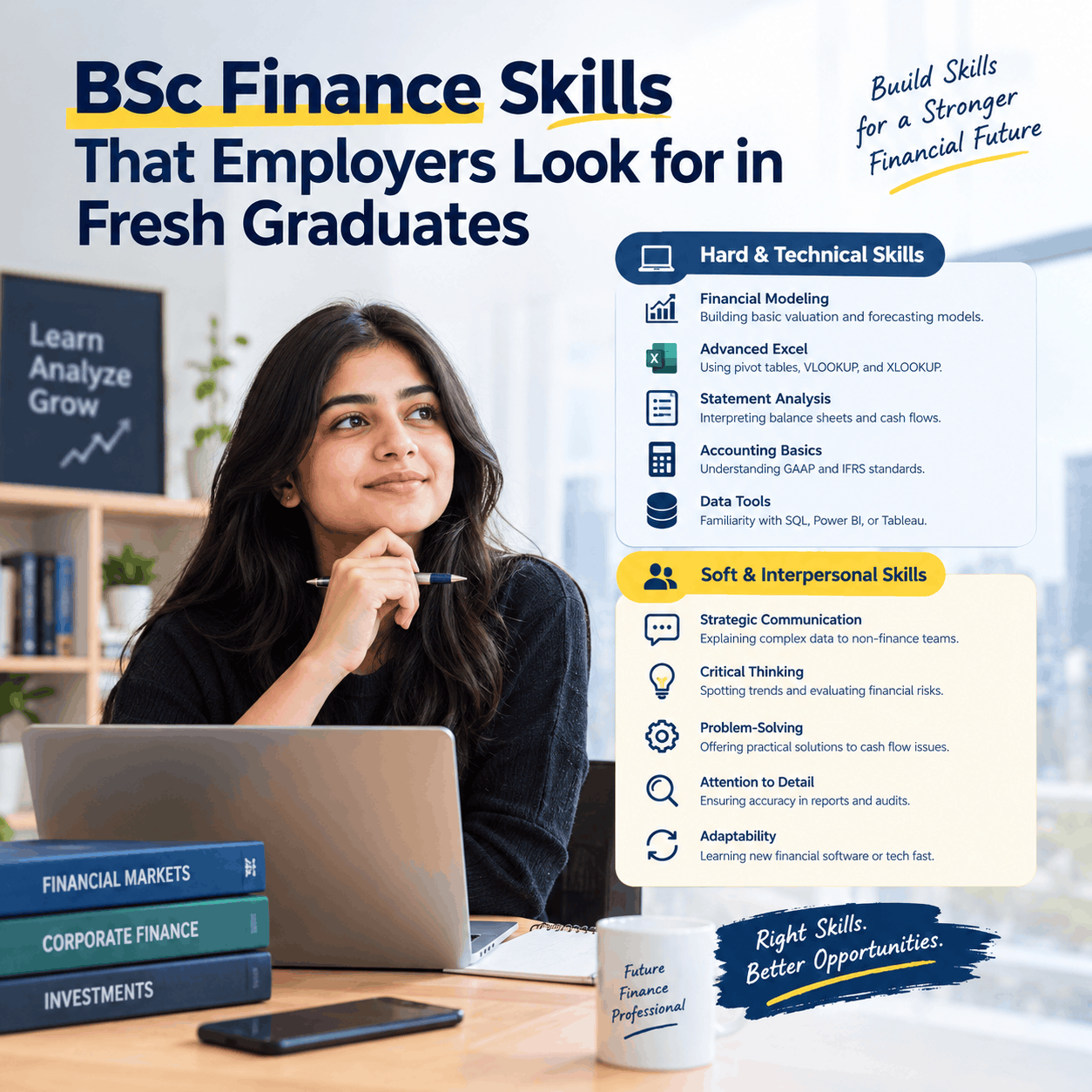
The future of capital markets will require professionals who can combine financial knowledge with analytical and technological skills.
Students should focus on developing skills in:
- Financial statement analysis
- Fundamental and technical analysis
- Financial modelling and Excel
- Portfolio management
- Derivatives and risk management
- Data analysis and technology
- Market regulations
- Research and communication
Students interested in specialised roles can also develop familiarity with Python, SQL and quantitative analysis, while professional certifications and market-focused qualifications can strengthen their understanding of the sector. NISM also emphasises the importance of specialised market knowledge and professional capabilities as India moves towards its next phase of capital-market development.
This is where the choice of BMS subjects and curriculum can make a difference. A specialised BMS in Capital Markets syllabus can expose students to areas such as financial accounting, corporate finance, fundamental analysis, technical analysis, derivatives, portfolio management and financial risk management.
Preparing for a Career in Capital Markets
For students comparing BMS colleges in Mumbai or researching capital market courses in Mumbai, it is important to look beyond the degree name and evaluate the curriculum, industry exposure and practical learning opportunities.
FinX Institute (formerly BSE Institute) offers a BMS in Capital Markets in Mumbai, combining management fundamentals with specialised capital-market learning and practical industry exposure.
As India’s financial markets become more digital, sophisticated and globally connected, students who build a strong foundation in finance, technology and market analysis can position themselves for a wide range of emerging career opportunities.
The future of capital markets will belong to professionals who do more than follow the markets; they understand how they work, analyse them intelligently and adapt as the industry evolves.
Visit: https://finxinstitute.com/undergraduate-courses/bms-in-capital-markets | Call: 1800 892 9030 | Email: Finxinstitute Training