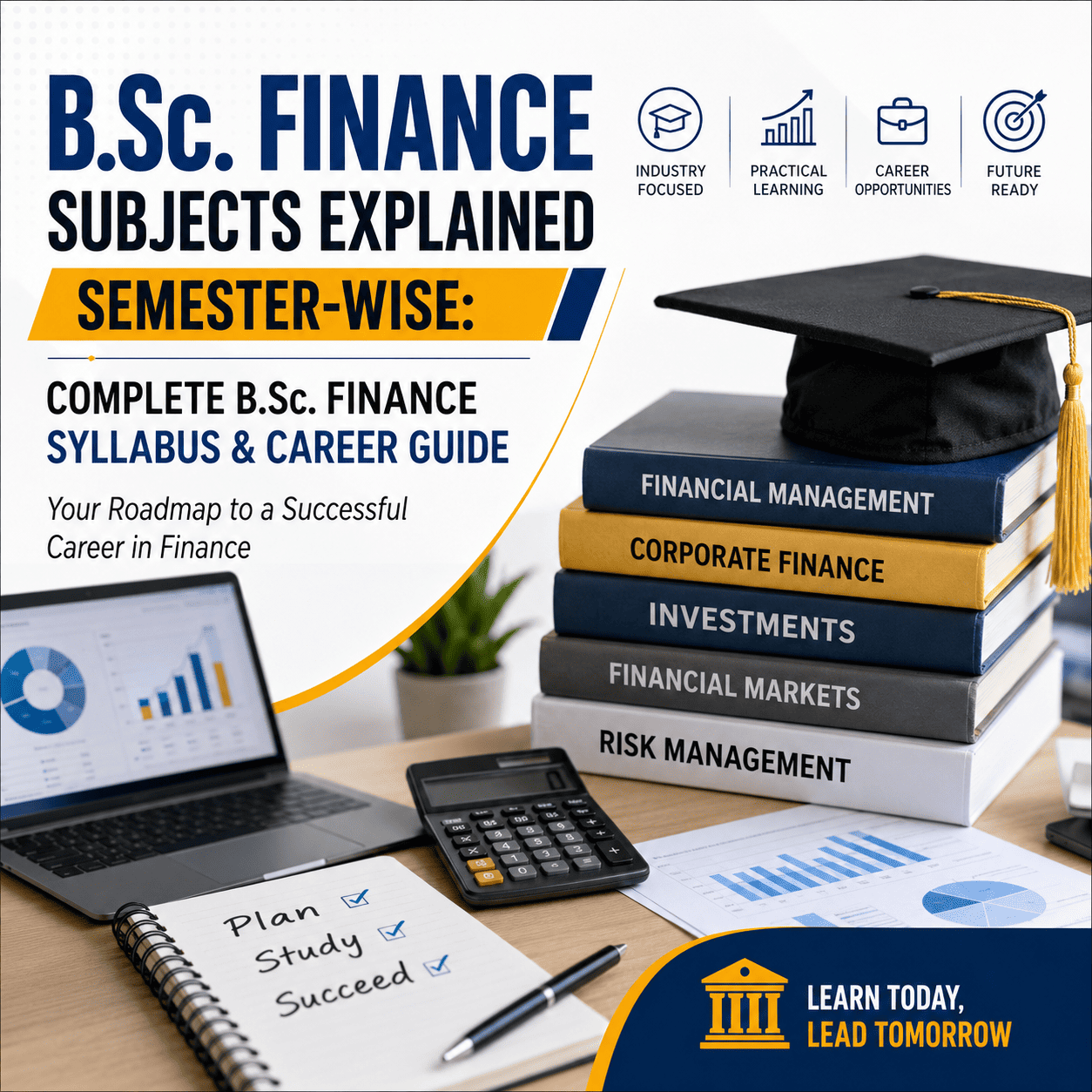
B.Sc. Finance Subjects Explained Semester-wise: Complete B.Sc. Finance Syllabus & Career Guide
Everyone offers advice, but students ultimately have to make the decision. Choosing the right undergraduate programme is one of the most important milestones for anyone aspiring to build a successful career in finance. Much like constructing a financial pyramid, a strong foundation is essential—one that remains resilient and adaptable in an ever-evolving financial landscape.
Amidst the countless degree options available after Class 12, choosing the right finance course after 12th can significantly influence your career. Among these options, B.Sc. in Finance stands out as one of the most comprehensive programmes for students aspiring to build careers in financial services, investment management, banking, and corporate finance. The true value of this programme lies in its carefully structured B.Sc. Finance subjects and industry-focused B.Sc. Finance syllabus, which combine academic learning with practical exposure.
The B.Sc. in Finance offered by FinX Institute (formerly BSE Institute) in collaboration with Homi Bhabha State University (HBSU) is designed to bridge academic learning with practical industry exposure. With a curriculum that evolves from financial fundamentals to advanced financial modelling, analytics, and international finance, students graduate with skills that today's employers actively seek.
Let's explore the semester-wise curriculum and understand how every stage contributes to building a future-ready finance professional.
Semester-wise B.Sc. Finance Subjects
The B.Sc. Finance syllabus is structured progressively, enabling students to build a strong foundation in finance. As per the National Education Policy (NEP) 2020, the programme follows a flexible academic framework. Students complete the three-year B.Sc. Finance degree across six semesters, with an optional honours fourth year in Semesters 7 and 8 to enhance academic performance, eligibility, and career aspirations.
Whether you are looking for an accounting and finance course that builds strong financial fundamentals or a banking and finance course that introduces you to capital markets, investments, and financial technology, the B.Sc. in Finance curriculum is designed to prepare students for multiple career pathways.
Semester 1 Subjects
The first semester introduces students to the fundamentals of finance, accounting, economics, and communication.
Core Subjects
- Financial Accounting
- Business Statistics
- Introduction to Financial Markets
- Business Economics – I
Additional Learning
- Business Communication
- Indian Ethos & Management Thoughts
- English
- Environmental Science
- Co-curricular Activities
Students develop a strong understanding of financial concepts while strengthening their analytical and communication skills.
Semester 2 Subjects
The second semester focuses on quantitative finance and financial analysis.
Core Subjects
- Financial Mathematics
- Quantitative Techniques
- Fundamental Analysis & Financial Reporting
- Business Economics – II
Additional Learning
- Business Ethics & Corporate Social Responsibility (CSR)
- Kautilya's Arthashastra
- Constitution of India
- English
- Co-curricular Activities
By the end of the first year, students possess a solid understanding of financial principles and the mathematical tools required for business decision-making.
Semester 3 Subjects
The third semester marks the beginning of specialised finance education and technology integration.
Core Subjects
- Technical Analysis
- Database Management System
- Corporate Finance
- Financial Derivatives
Skill Enhancement
- Excel & Advanced Excel
Students also continue language studies while participating in sports and co-curricular activities, helping them develop both technical and interpersonal skills.
Semester 4 Subjects
The fourth semester introduces students to global finance, analytics, and programming.
Core Subjects
- Debt Markets
- Python for Finance
- Econometrics
- International Finance
Skill Enhancement
- Leadership Development
This semester prepares students to understand international financial systems while gaining practical exposure to data-driven financial analysis.
Semester 5 Subjects
The fifth semester emphasises professional applications of finance.
Core Subjects
- Applied Econometrics
- Business Analytics
- Financial Risk Management
Electives
- Financial Planning
- Project Finance
Vocational Learning
- Foreign Trade Procedures & Practices – I
Practical Component
- Field Project (On-the-Job Training)
Students gain valuable industry exposure by applying classroom concepts to real-world financial scenarios.
Semester 6 Subjects
The final semester of the three-year programme focuses on advanced financial decision-making.
Core Subjects
- Behavioural Finance
- Financial Modelling
- Mergers & Acquisitions
Electives
- Portfolio Management
- Foreign Exchange Management
Vocational Learning
- Foreign Trade Procedures & Practices – II
Practical Component
- Field Project
These subjects prepare students for careers in investment banking, corporate finance, wealth management, risk management, and financial consulting.
Optional Fourth Year (Honours) under NEP 2020
Students who wish to pursue advanced academic and industry-focused learning may choose to continue into the fourth year of the programme, subject to the university's eligibility criteria and regulations.
The honours year offers an opportunity to deepen domain expertise through advanced coursework, research, internships, and project-based learning. It is particularly beneficial for students planning to pursue higher education, research, specialised finance roles, or global career opportunities.
Practical Learning That Goes Beyond the Classroom
One of the biggest strengths of the programme is its emphasis on experiential learning.
Students gain exposure through:
- Real-world case studies
- Industry simulations
- Hands-on finance assignments
- Expert-led classroom sessions
- Practical financial analysis
- Market-oriented projects
This practical approach makes the programme much more than a traditional accounting and finance course, allowing students to solve real business and financial challenges.
Industry Projects & Professional Exposure
Modern finance employers value experience as much as academic knowledge.
The programme incorporates:
- Field Projects
- On-the-Job Training (OJT)
- Industry interactions
- Practical finance exercises
- Expert mentoring from experienced professionals
Students learn how financial decisions are made in actual business environments, helping them transition smoothly from classroom learning to professional careers.
Skills Developed Throughout the Programme
A well-designed B.Sc. Finance syllabus develops much more than subject knowledge.
Graduates build expertise in:
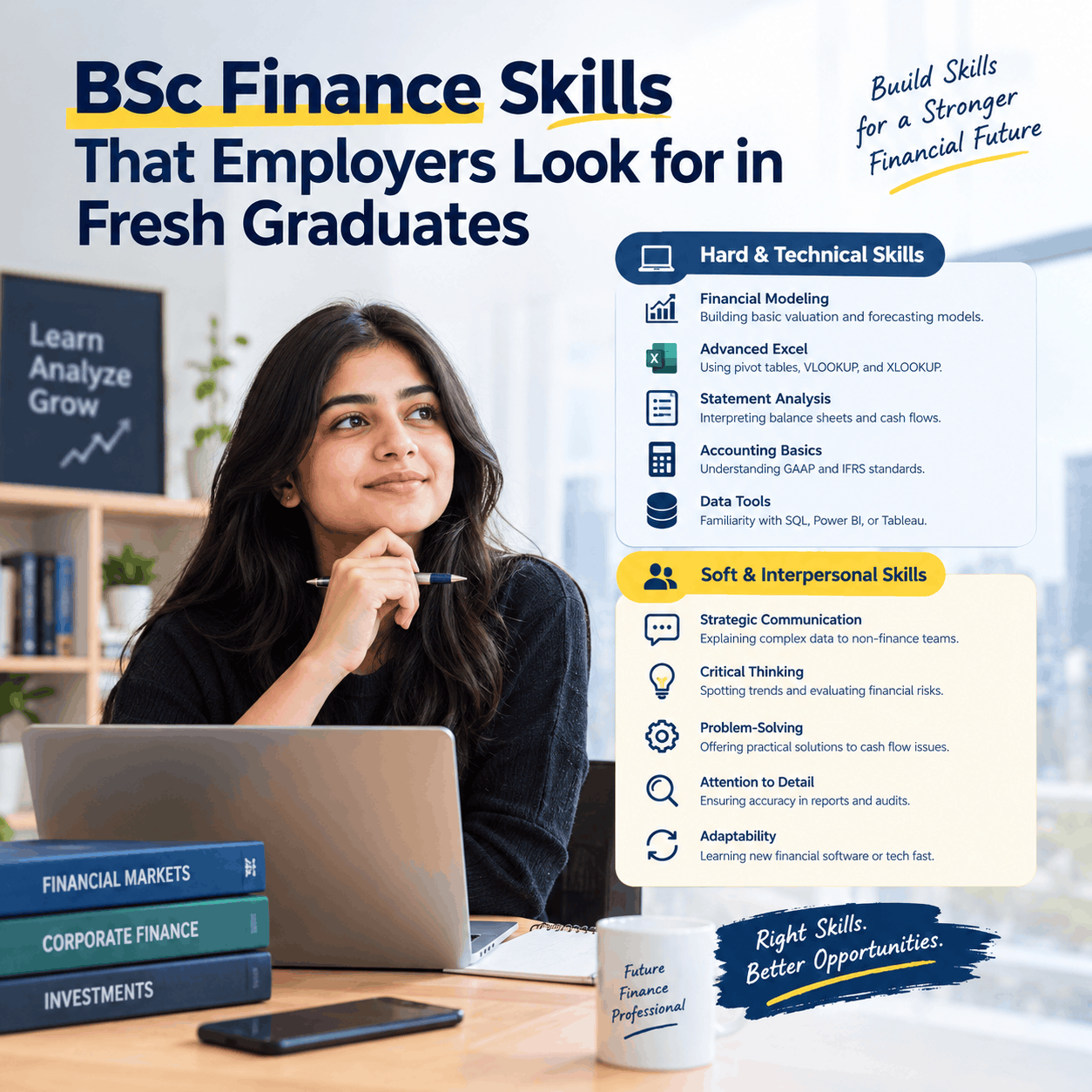
- Financial Analysis
- Investment Decision Making
- Quantitative Analysis
- Risk Assessment
- Corporate Finance
- Financial Modelling
- Business Analytics
- Data Interpretation
- Python for Finance
- Communication & Leadership
- Problem Solving
- Decision Making
These skills are increasingly essential as finance becomes more technology-driven and data-oriented.
Career Relevance
Since the programme combines elements of an accounting and finance course and a banking and finance course, graduates are well prepared for careers across investment after completing a Bachelor's degree in Finance, and explore careers across multiple sectors, including:
- Investment Banking
- Corporate Finance
- Equity Research
- Risk Management
- Financial Consulting
- FinTech
- Wealth Management
- Banking
- Financial Planning
The programme also provides a strong academic foundation for professional certifications and higher education, including MBA, CFA, and FRM.
Why Choose FinX Institute (formerly BSE Institute) for B.Sc. Finance?
For students comparing B.Sc. Finance colleges in Mumbai, FinX Institute (formerly BSE Institute) offers a distinct advantage through its industry-oriented curriculum, experienced faculty, practical learning approach, and strong connection with the financial services ecosystem. The programme is designed to equip students with both academic knowledge and job-ready skills required by today's finance industry. Backed by decades of expertise in finance education and guided by industry-experienced faculty, FinX Institute delivers a BFSI-oriented curriculum that seamlessly combines academic excellence with practical application.
Some of its key strengths include:
- Collaboration with Homi Bhabha State University (HBSU)
- Curriculum aligned with current finance industry requirements
- Experienced faculty comprising academicians and industry professionals
- Hands-on projects and practical assignments
- Exposure to financial markets and emerging technologies
- Strong focus on analytical and quantitative finance
The programme is specifically designed for students who aspire to build long-term careers in finance rather than pursuing a general commerce education.
Final Thoughts
Understanding the B.Sc. Finance subjects before choosing a degree can help students make an informed career decision. A strong curriculum should not only cover financial theory but also equip learners with practical skills, technological expertise, and real-world exposure.
The B.Sc. Finance syllabus at FinX Institute (formerly BSE Institute) reflects the evolving needs of the global finance industry by combining financial markets, quantitative analysis, analytics, programming, risk management, and experiential learning into a comprehensive undergraduate programme.
For students looking to build a career in banking, investment management, corporate finance, fintech, or financial consulting, this programme provides the knowledge, practical experience, and industry exposure needed to succeed in today's competitive financial landscape.
Frequently Asked Questions (FAQs)
1. What are the main B.Sc. Finance subjects?
The programme includes Financial Accounting, Business Statistics, Financial Mathematics, Corporate Finance, Technical Analysis, Financial Derivatives, Python for Finance, Financial Modelling, Behavioural Finance, Portfolio Management, Business Analytics, and Risk Management.
2. What is included in the B.Sc. Finance syllabus?
The syllabus combines finance, economics, quantitative techniques, analytics, technology, leadership development, vocational learning, and industry projects to create a comprehensive finance education.
3. Does the programme include practical learning?
Yes. Students participate in case studies, simulations, hands-on assignments, field projects, and on-the-job training to gain practical industry exposure.
4. Is Python included in the curriculum?
Yes. Students study Python for Finance, enabling them to analyse financial data and solve business problems using programming.
5. What career opportunities are available after a B.Sc. Finance?
Graduates can pursue careers in investment banking, corporate finance, equity research, financial consulting, risk management, fintech, banking, and wealth management, while also preparing for higher studies like MBA, CFA, or FRM.