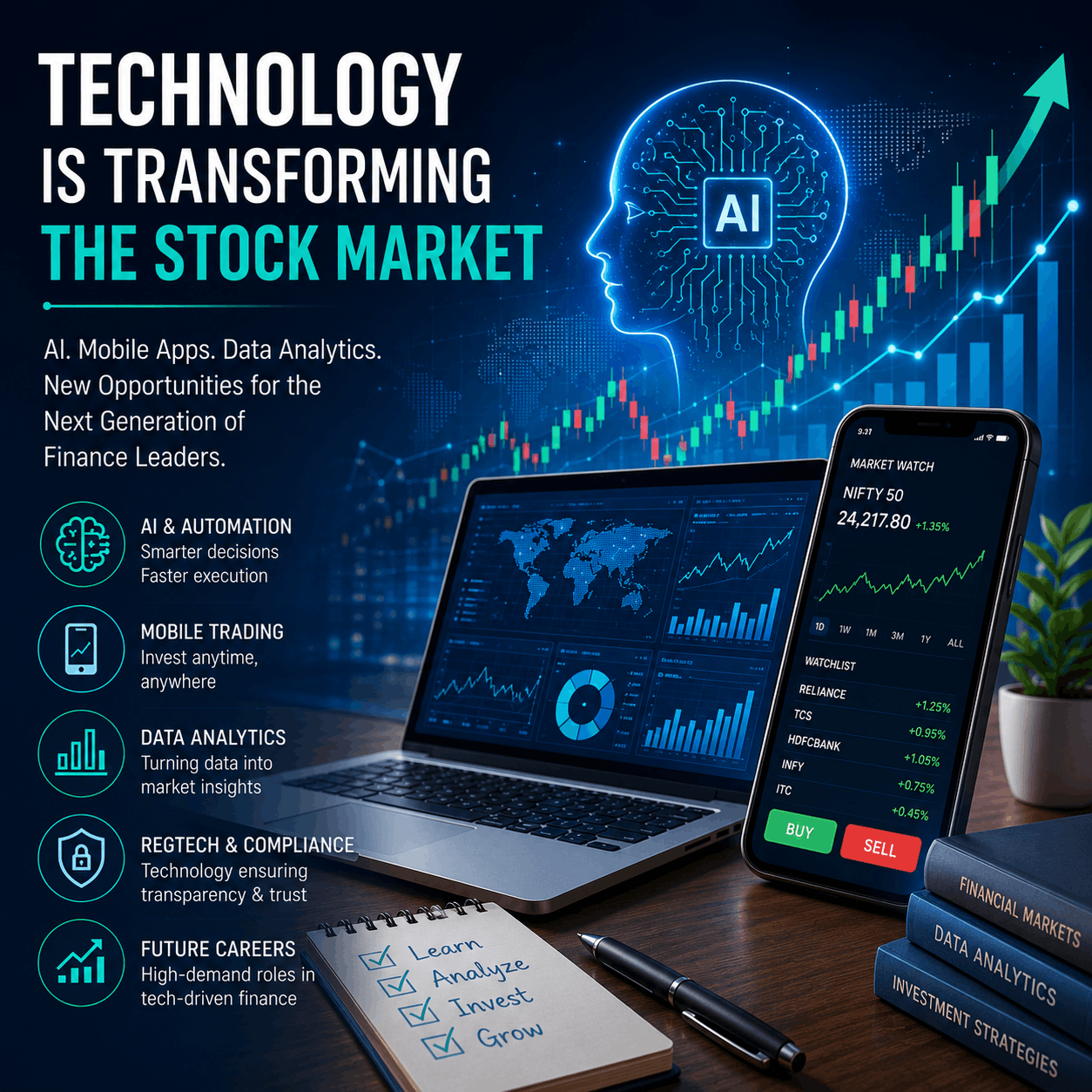
The stock market has always relied on information, but technology has revolutionised investing and trading in recent years. From AI-powered research tools to smartphone apps that provide access to BSE and NSE, the capital markets are undergoing a significant technological transformation.
For BMS students specialising in Capital Markets, understanding these changes is crucial for their future careers. Financial professionals will need to strategically harness technology and apply it within India’s regulatory frameworks.
This blog highlights the five key ways technology is impacting the stock market and what it means for BMS graduates entering this evolving industry.
Rise of AI and Automation in Stock Markets
Artificial intelligence and automation are no longer futuristic concepts in finance; they are the present-day operating reality of stock markets worldwide, including in India. From the moment markets open to the final bell, AI-driven systems are monitoring price movements, detecting patterns, executing trades, managing risk, and generating research—often in milliseconds.
1. AI in Equity Research and Stock Screening
Equity research, historically a manual and time-intensive process, has been transformed by Natural Language Processing (NLP) and Machine Learning. Platforms powered by AI can now scan thousands of company earnings calls, annual reports, and news articles in real time, extracting sentiment signals and financial metrics that would take human analysts weeks to compile. SEBI’s regulatory framework for Research Analysts has also evolved to account for these new AI-assisted methodologies.
2. Robo-Advisory and Automated Portfolio Management
Robo-advisors—algorithm-driven platforms that create and manage personalised investment portfolios—are rapidly democratising wealth management in India. SEBI’s Investment Adviser Regulation has created a defined framework for these platforms, enabling registered fintech firms to serve millions of retail investors at a fraction of the cost of traditional advisory services.
3. Fraud Detection and Surveillance
Stock exchanges and SEBI use AI-powered surveillance systems to detect unusual trading patterns, front-running, pump-and-dump schemes, and other forms of market manipulation. These systems analyse millions of transactions every day, flagging anomalies that human surveillance teams would be unable to detect at such scale or speed, making markets safer and more transparent for all participants.
AI is not simply automating existing tasks; it is enabling entirely new categories of analysis, risk management, and investor service that were previously impossible. For BMS graduates, this means a world of career opportunities at the frontier of finance and technology.
How Mobile Trading Apps Changed Investing
The rise of mobile trading applications has greatly democratized investing in India. A decade ago, stock market participation required a full-service broker and significant paperwork, limiting access. Now, anyone with a smartphone and a PAN card can quickly open a demat account and invest in equities, mutual funds, F&O, and IPOs.
The Scale of the Mobile Trading Revolution
India’s demat account count has surpassed 160 million, with CDSL reporting record monthly additions consistently since 2021. Discount brokers like Zerodha, Groww, and Upstox have collectively onboarded tens of millions of first-time investors, predominantly from Tier 2 and Tier 3 cities, who would previously never have participated in capital markets.
Key Features Driving Adoption
Modern mobile trading platforms have redefined the investor experience through several transformation features:
- Zero or low-cost brokerage - eliminating a major barrier for small retail investors
- Instant digital KYC (eKYC via Aadhaar) - enabling account opening in under 15 minutes
- Intuitive, jargon-free UI/UX - making market participation accessible to first-time investors
- Real-time data, charts, and news - providing retail investors with institutional-grade market intelligence
- SIP-based equity investing - allowing disciplined, small-ticket participation in equity markets
- In-app financial education - building long-term investor literacy at scale
Career Opportunities in the Mobile Trading Ecosystem
The mobile trading revolution has created entirely new career verticals that did not exist a decade ago. BMS degree holders with capital markets knowledge are in high demand at fintech companies for roles in product management, customer success, content and investor education, compliance, and data analytics. Understanding how these platforms work, from regulatory compliance to customer journey design, is a significant career differentiator.
Career Insight: India's top discount broking firms collectively employ thousands of capital market professionals spanning technology, operations, compliance, research, and customer experience. A BMS course with capital markets specialisation is one of the most relevant qualifications for these roles.
Impact of Data Analytics on Market Research
The modern stock market generates an almost incomprehensible volume of data: price ticks, order book activity, corporate filings, macroeconomic indicators, social media sentiment, satellite imagery of retail parking lots, shipping container movements, and much more. The ability to extract meaningful insights from this data torrent has become one of the most prized skills in the financial industry.
The Shift to Quantitative and Data-Driven Research
Traditional equity research relied primarily on qualitative assessments of management quality, industry dynamics, and company fundamentals, synthesised into buy/sell/hold recommendations. While these remain important, quantitative analysis using large datasets has dramatically enhanced the precision, speed, and depth of market research. Factor-based investing models, for instance, use data analytics to identify stocks with specific financial characteristics, such as high return on equity, low price-to-book, or strong earnings momentum, that have historically been associated with outperformance.
Alternative Data: The New Frontier
Beyond traditional financial data, institutional investors are increasingly leveraging alternative data to gain an informational edge. This includes:
- Satellite imagery - monitoring factory activity levels, oil storage inventories, or retail foot traffic
- Credit card transaction data - tracking consumer spending trends in real time
- Web scraping and social media analytics - gauging brand sentiment and consumer confidence
- Job posting analytics - inferring corporate hiring intent and expansion plans
- App download and usage data - tracking the growth of digital businesses
As these data sources become more accessible, capital market professionals who can interpret and apply alternative data will have a significant edge. A BMS course that incorporates data literacy and financial analytics is therefore increasingly valuable.
Data Analytics Tools Shaping Market Research
The toolkit of a modern capital market analyst has expanded well beyond Excel. Python libraries like Pandas and NumPy are now standard for data manipulation, while Bloomberg Terminal and Refinitiv Eikon provide comprehensive financial data platforms. SEBI's enhanced SCORES platform and data repositories are also being utilised for compliance analytics.
Data is the new oil of financial markets—but raw data alone creates no value. The professionals who will lead India's capital markets in the next decade are those who can transform data into decisions. This is the core competency that a strong BMS degree in Capital Markets must develop.
Future Career Opportunities in Tech-Driven Financial Markets
Technology is redefining careers in capital markets, particularly affecting those in repetitive, rules-based roles. In demand are professionals with financial expertise, technical skills, strategic thinking, and strong communication abilities. It's a great time for BMS graduates specialising in capital markets.
High-Demand Roles at the Finance-Technology Intersection
The following career pathways are experiencing sustained, strong demand growth driven directly by technological transformation:
- Quantitative Analyst (Quant)
- Algorithmic Trading Strategist
- Financial Data Analyst
- RegTech & Compliance Analyst
- WealthTech Product Manager
- ESG & Sustainability Analyst
- Risk Technology Specialist
- Investor Relations & Financial Communications Manager
Certifications That Amplify Your BMS Degree
A BMS degree in Capital Markets provides a strong academic foundation, but combining it with industry certifications amplifies your value to employers significantly. The NISM Certification Examinations—including Series VIII (Equity Derivatives), Series XV (Research Analyst), and Series X-A/B (Investment Adviser)—are SEBI-mandated credentials for specific capital market roles. The CFA Foundation Level and FRM (Financial Risk Manager) are also highly valued for quantitative and research-oriented career paths.
Why FinX Institute's BMS is Built for This Future
At FinX Institute (formerly BSE Institute), the BMS in Capital Markets curriculum has been purpose-built to prepare graduates for exactly this tech-driven financial marketplace. The programme integrates:
- Live Bloomberg Terminal access and training - developing real-world data and analytics proficiency
- Financial modelling and Python for Finance modules - equipping students with quantitative tools
- Market simulations and live trading practice - building practical decision-making skills under real market conditions
- NISM certification preparation - ensuring regulatory credibility from Day 1 of employment
- Industry mentorship from active capital market practitioners - providing unparalleled professional context
- Strong placement network with broking firms, asset managers, banks, and fintech companies
Conclusion
The technological transformation of India's stock market is not a distant trend; it is happening right now, reshaping every corner of the financial industry from research and trading to compliance and customer service. For students choosing a BMS degree course today, specialising in Capital Markets means choosing a career path that is at the very heart of this transformation.
The professionals who will thrive in this new landscape are not just those who understand finance; they are those who understand finance as it is actually practised in a technology-driven world. A BMS course from FinX Institute equips you with precisely this combination: deep capital market knowledge, practical technology skills, industry certifications, and the professional networks to turn your degree into a meaningful career.
Visit: finxinstitute.com | Call: 1800 892 9030 | Email: Finxinstitute Training