What Does a Data-Driven Financial Market Mean?
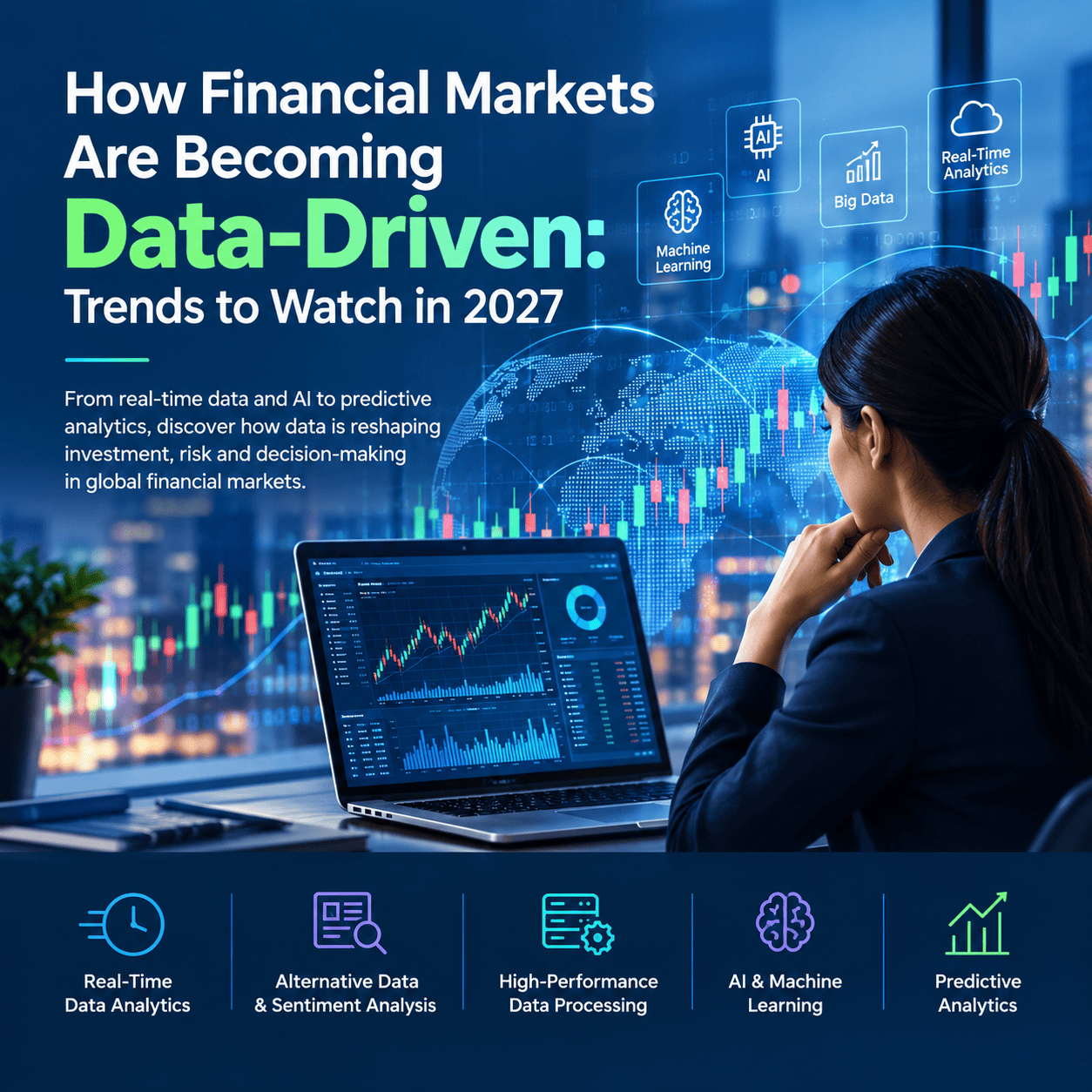
A data-driven financial market uses quantitative information and analytical models to support decisions that once depended heavily on manual research and delayed reports. Market prices, transaction flows, company data, economic indicators, news sentiments, and alternative datasets can now be analysed together. This can help institutions identify patterns, monitor risks and respond more quickly to changing conditions.
What Big Data Analytics Trends Will Shape Financial Markets in 2027?
Real-Time Data Analytics
Real-time analytics is becoming increasingly important because trading, credit, and risk decisions can change within seconds. The International Monetary Fund (IMF) notes that AI- supported trading and supervisory analytics are increasingly occurring in real time. In 2027, institutions are likely to invest further in systems capable of processing continuously changing market information.
Alternative Data and Sentiment Analysis
Financial analysis is also moving beyond financial statements. News, earnings-call transcripts, social sentiment, and alternative data sets can add context around markets and companies. Natural Language Processing (NLP) can help convert this unstructured information into signals that analysts evaluate alongside conventional financial data.
High-Performance Data Processing
As datasets grow in size and complexity, institutions need infrastructure capable of processing information quickly. High-performance computing can support large-scale modelling, simulations and big data analytics, enabling financial teams to analyse more variables without relying only on end-of-day processes.
How Are AI and Machine Learning Changing Financial Decision-Making?
AI and machine learning are making financial analysis faster and more scalable. Models can identify patterns across large datasets, support fraud detection, assess credit risk, and help investment teams process information. CFA Institute research published in 2026 also highlights how AI could reshape information processing, capital allocation, risk management and professional skills across finance.
Students can also explore how AI is changing stock market research to understand how these technologies are influencing investment analysis.
How Is Predictive Analytics Being Used in Finance?
Predictive analytics uses historical and current data to estimate likely future outcomes. In finance, it can support market-trend analysis, fraud detection, credit-risk assessment, customer behaviour modelling and portfolio risk management.
Rather than guaranteeing an outcome, predictive models help professionals quantify probabilities and support more evidence-based decisions.
Why Will Time Series Analytics Matter More in 2027?
Financial information is fundamentally chronological. Prices, returns, interest rates, trading volumes and volatility all evolve. Time series modelling helps analysts identify trends, cycles and relationships within sequential data. As institutions work with larger volumes of real-time information, these techniques can becomes increasingly useful for forecasting and risk analysis.
Why Are Big Data and Predictive Analytics Skills Important for Finance Careers?
The growth of data-led finance is increasing the importance of professionals who understand both analytics and business decision-making. Skills in big data analytics, Python, statistics, machine learning, visualisation and predictive modelling can support careers across financial analytics, risk, fintech, business intelligence and data science.
For graduates comparing big data analytics courses, practical exposure to these tools and their real-world applications should be an important consideration.
Build Data-Driven Skills with FinX Institute’s PGDPA
The Post Graduate Diploma in Predictive Analytics (PGDPA) at FinX Institute (formerly BSE Institute) is a one-year programme offered in collaboration with the University of Mumbai’s Garware Institute of Career Education & Development (GICED).
Its curriculum includes Big Data Analytics, Statistical Computing and Statistics using Python, Machine Learning, Data Visualization, High Performance Computing and Time Series Modelling, connecting directly with many of the trends shaping data-driven industries.
Explore the PGDPA at FinX Institute and build practical analytical skills for an increasingly data-driven future.