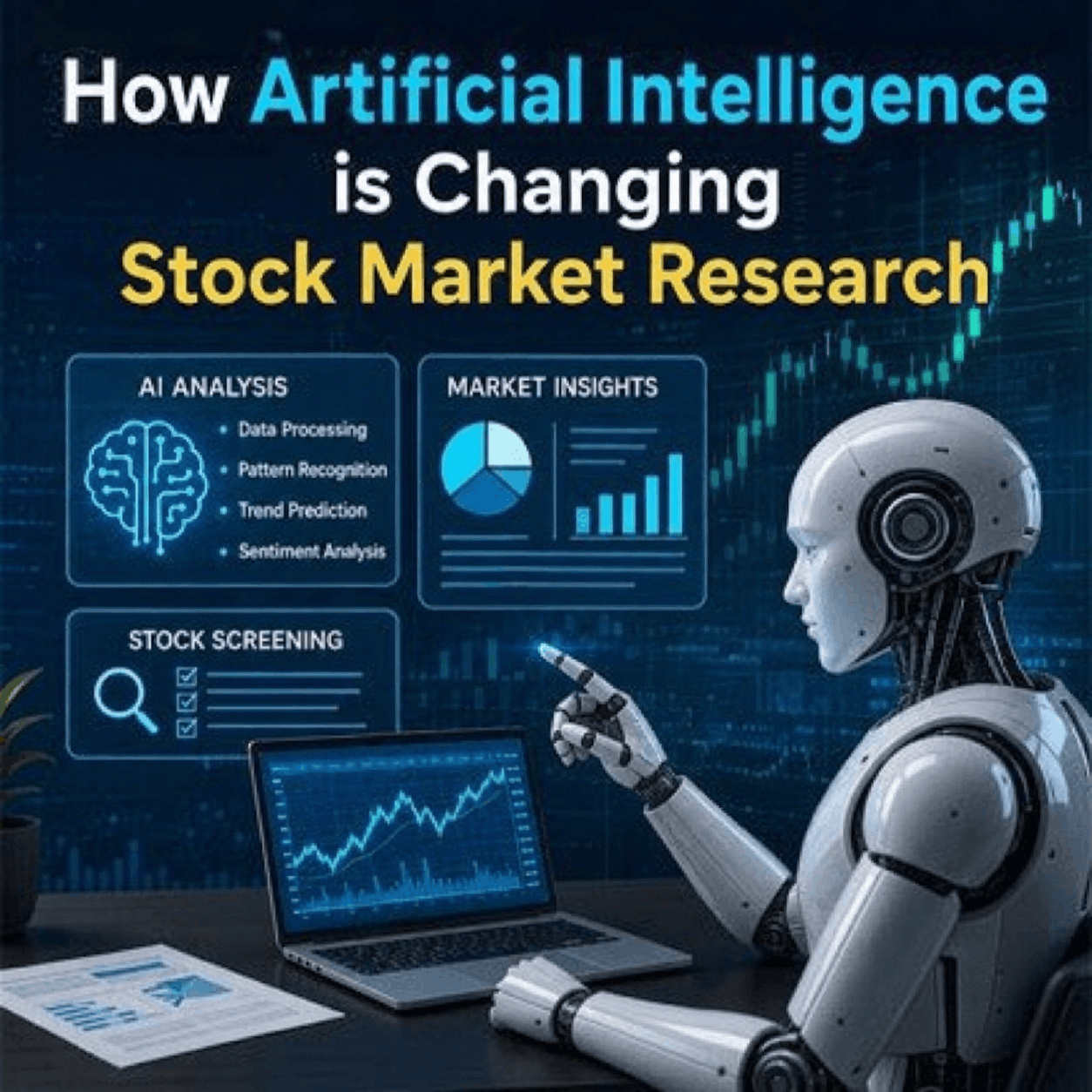
How Artificial Intelligence is Changing Stock Market Research
Artificial Intelligence (AI) is changing how investors and financial professionals research companies and financial markets. Tasks that once required hours of reading annual reports, earnings calls, news, and market data can now be supported by AI systems capable of processing large volumes of information quickly.
For students exploring a BMS in Capital Markets, a capital markets degree, or even a stock market degree after 12th commerce, understanding AI is becoming increasingly important. The future of investment research is likely to depend on professionals who can combine financial knowledge with intelligent technology.
1. How AI Will Help Stock Market Research
AI can make stock market research faster, broader and more data-driven. Modern systems can examine financial statements, company announcements, news reports, earnings-call transcripts and market data to identify patterns that may be difficult to spot manually.
Natural Language Processing (NLP) can help analyse context and sentiment within corporate disclosures, reports and management commentary. AI can also make stock screening more sophisticated by allowing investors to evaluate companies across multiple financial and qualitative parameters.
According to Microsoft, AI-powered analytics can help financial researchers analyse historical patterns, identify emerging trends and automate time-consuming research activities.
However, AI should be considered a research tool rather than a guaranteed market-prediction system.
2. Limitations and Risks of AI in Investing
AI is powerful, but financial markets remain unpredictable.
One challenge is the “black box” problem, in which sophisticated AI models may produce results without making their reasoning readily understandable. This can create concerns around transparency, accountability, and decision-making.
AI systems also depend heavily on data quality. Incomplete, biased, or outdated information can lead to unreliable conclusions. Models can also overfit historical data, identifying patterns that worked in the past but fail when market conditions change.
The Bank for International Settlements has highlighted risks related to AI, including model opacity, data issues and the possibility of AI adoption amplifying financial vulnerabilities.
This is why human oversight, risk management and independent verification remain essential.
3. How AI Analyzes Financial Data Faster Than Humans
A research analyst may need to manually read reports, compare spreadsheets and monitor multiple information sources. AI can perform many repetitive data-processing tasks simultaneously.
It can organise structured information such as revenue, margins, debt levels, and valuation ratios while also examining unstructured information such as news articles, corporate reports, and transcripts.
AI's advantage is primarily scale and speed. Human analysts remain important for interpreting factors such as management quality, competitive advantages, regulatory developments and unexpected market events.
For students studying finance-focused BMS subjects, combining accounting, valuation and market knowledge with data-analysis skills can provide a valuable advantage.
4. The Evolution of Stock Market Research in the AI Era
Stock market research has progressed from paper reports and hand-drawn charts to spreadsheets, financial databases, quantitative models and now AI-assisted research.
The present stage is increasingly a “human + AI” model. AI can handle repetitive information processing and pattern recognition, while professionals determine whether those patterns make financial and economic sense.
For students considering a BMS course, this evolution changes what it means to be prepared for a career in finance. Understanding financial statements and markets remains essential, but familiarity with analytics, AI and digital tools can add another layer of capability.
5. How AI Will Help To Generate More Income
AI cannot guarantee higher returns or risk-free income. Instead, its value lies in helping investors and financial institutions make faster and potentially better-informed decisions.
AI can support portfolio monitoring, risk analysis, asset allocation, scenario analysis and the identification of potential investment opportunities. Automated advisory platforms can also make certain portfolio-management tools more accessible.
At an institutional level, EY highlights how financial-services firms are using AI to improve efficiency, client engagement and business growth.
The opportunity therefore lies not in allowing AI to make investment decisions blindly, but in using it to strengthen research and decision-making.
Preparing for AI-Driven Capital Markets
For students researching capital market courses in Mumbai or BMS in Capital Market colleges in Mumbai, it is important to evaluate whether the curriculum reflects the evolving financial industry.
FinX Institute (formerly BSE Institute) offers a BMS in Capital Markets in Mumbai. The BMS in Capital Markets syllabus covers areas such as Capital Markets, Equity Research, Portfolio Management, Financial Accounting, Business Law, and International Finance, building a foundation across management and financial-market concepts.
As AI becomes more integrated into financial services, professionals who understand both technology and the fundamentals of investing will be better prepared for the changing industry. AI may transform how stock market research is conducted, but financial knowledge, critical thinking, and human judgement will remain essential.
Visit: finxinstitute.com | Call: 1800 892 9030 | Email: Finxinstitute Training
```