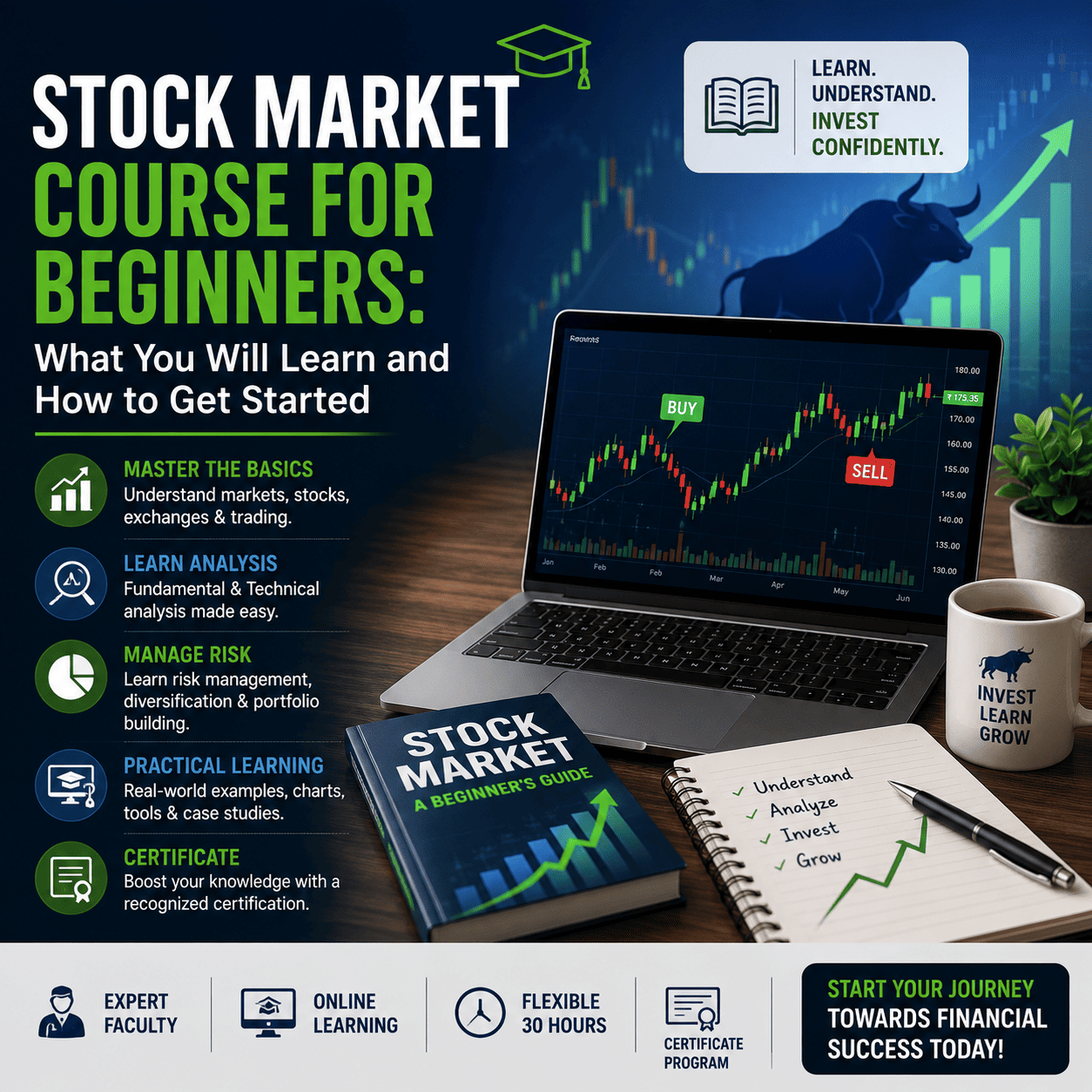
Stock Market Course for Beginners: What You Will Learn and How to Get Started
Terms such as equities, derivatives, candlestick charts, market orders, and portfolio can seem complex when you're just starting in the stock market.
For this, a well-structured stock market course for beginners can make the learning process easier by introducing foundational concepts. These concepts can equip learners to understand how markets work, how investments are analysed, and how risk should be managed before making financial decisions for oneself.
What Is a Stock Market Course?
A stock market course is designed for learners to understand concepts such as primary and secondary markets, stock exchanges, DEMAT accounts, trading mechanisms, and settlement processes. They can then progress towards areas such as fundamental analysis, technical analysis, derivatives and portfolio management.
Why Should Beginners Learn About the Stock Market?
Learning about the stock market is useful even if you do not plan to become an active trader.
Stocks represent ownership in companies, while stock markets provide a mechanism through which companies can raise capital and investors can buy and sell securities.
For students and working professionals, stock market knowledge can also build a foundation for understanding fields such as investment research, wealth management, broking, financial services and portfolio management.
Most importantly, learning how markets work can help beginners distinguish between informed analysis and speculation.
What Do You Learn in a Stock Market Course?
A well-structured beginner course goes beyond simply explaining how to buy and sell shares to understand the whole system of the stock market.
Learners should first understand the capital market ecosystem, including primary and secondary markets, DEMAT accounts, depositories, trading mechanisms, clearing and settlement.
The next step is understanding different investment products. This may include equities, mutual funds, fixed-income securities, bonds, commodities, currencies, and derivatives such as futures and options.
Analysis is another important part of stock market education. Fundamental analysis helps learners understand financial statements, ratios, industries and companies, while technical analysis introduces charts, candlestick patterns, trends, support and resistance, and other methods of studying market behaviour.
Risk management is equally important. Beginners should understand returns, measurement of risk, diversification, asset allocation, and portfolio construction rather than focusing only on potential profits.
FinX Institute's Certificate Program in Stock Market (CPSM) brings these areas together through modules covering capital markets, trading mechanisms, mutual funds, fixed income, derivatives, financial statement analysis, fundamental analysis, technical analysis, commodities, currencies, wealth management, diversification and taxation.
Who Should Consider a Stock Market Course?
Students interested in finance can use the learnings from the course to build an early understanding of capital markets. Working professionals can deepen their knowledge of investment products and market analysis, while aspiring investors can learn the principles of evaluating opportunities and managing risk.
It can also benefit learners exploring careers connected with financial markets who want a structured introduction before moving towards more specialised qualifications or roles.
Beginners do not need to approach the subject to become full-time traders. Understanding markets themselves can be a valuable financial skill.
How to Choose the Right Stock Market Course for Beginners?
A good stock market course should provide a structured curriculum covering market fundamentals as well as practical areas of analysis. Consider whether the course includes:
- Stock market fundamentals and trading mechanisms
- Fundamental and technical analysis
- Financial statement analysis
- Investment products and derivatives
- Risk management and diversification
- Practical market-oriented learning
- Guidance from experienced faculty
Learners should also consider the course duration, learning mode, and whether the curriculum matches their current level of knowledge.
For example, the Certificate Program in Stock Market at FinX Institute is currently presented as a beginner-level, online program with 30 hours of learning.
Is a Stock Market Course Worth It for Beginners?
A stock market course online can be worthwhile when the objective is to develop structured knowledge rather than search for guaranteed trading returns.
Beginners often have access to enormous amounts of free information, but the challenge is knowing what to learn first and how different concepts connect. A structured course creates a learning path covering markets, products, analysis, and risk before learners begin making independent decisions.
For those looking to build this foundation, the Certificate Program in Stock Market (CPSM) at FinX Institute offers structured learning across capital markets, investment products, fundamental and technical analysis, derivatives, portfolio concepts and risk management.
Ultimately, learning about the stock market should not be viewed as a shortcut to quick profits. It is about developing the knowledge, analytical approach and risk awareness required to understand markets and make more informed financial decisions.