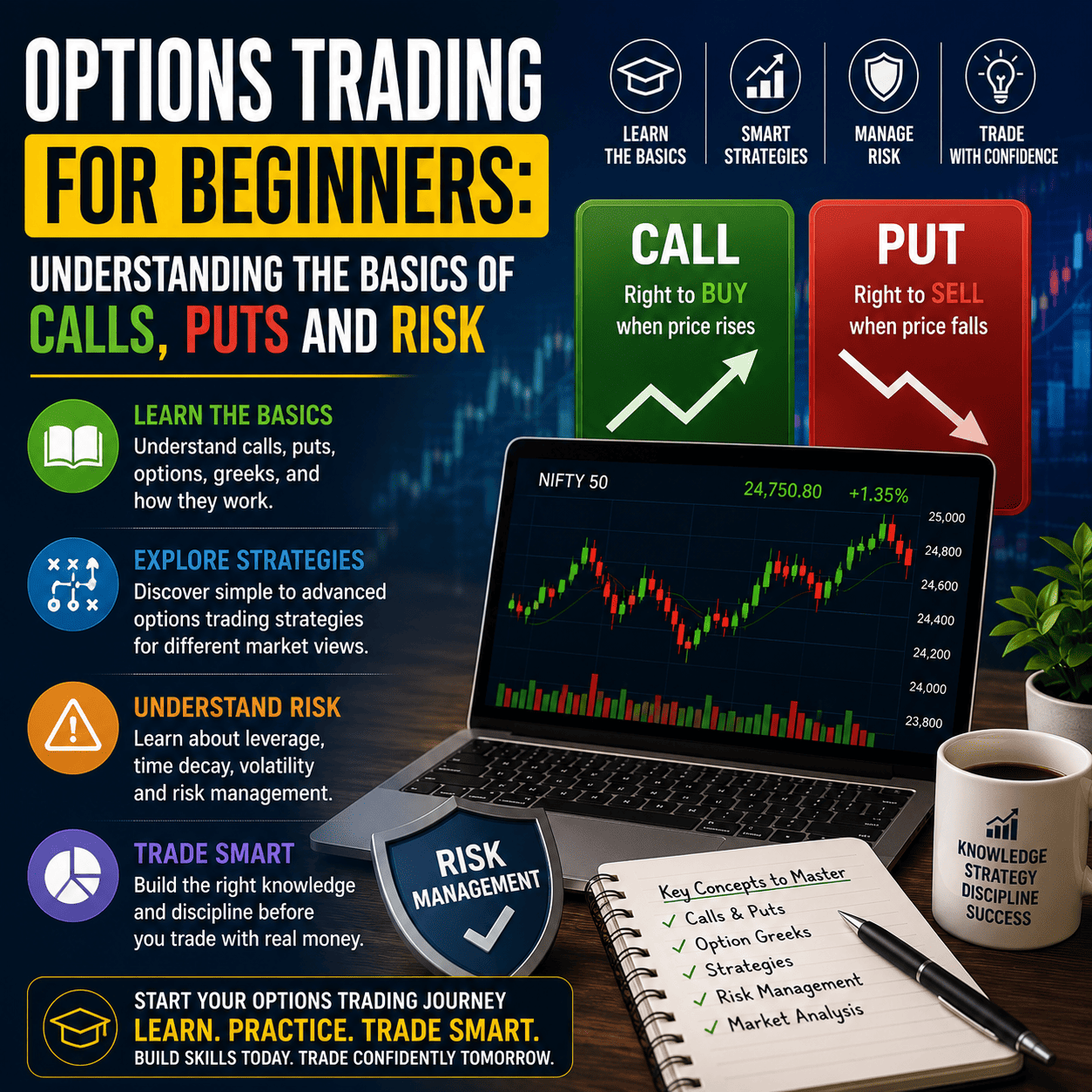
Options Trading for Beginners: Understanding the Basics of Calls, Puts and Risk
Options trading looks attractive because it offers flexibility, leverage, and multiple ways to respond to market movements. But for beginners, options are not simply “higher-speed stocks.” They are derivative contracts whose value can depend on the underlying asset, time to expiry and volatility. Understanding these options trading basics is essential before placing a trade.
What Is Options Trading?
An option is a derivative contract that gives the buyer the right, but not the obligation, to buy or sell an underlying asset at a predetermined price under specified contract terms. A call gives the buyer the right to buy; a put gives the buyer the right to sell. SEBI's guide to understanding derivatives explains options as part of the futures and options segment of the securities market.
Every option has a strike price, expiry date, and premium. In India, contract lot sizes vary by underlying and exchange specifications, so traders should check the latest NSE equity derivatives contract information rather than assume a fixed number of shares per contract.
What Are Call and Put Options?
A call and put options is generally used when a trader expects the underlying price to rise. If the market moves sufficiently above the strike price, the call may gain value, although the outcome also depends on the premium, time remaining and volatility.
A put option gives the buyer the right to sell the underlying at the strike price and may be used to express a bearish view or as part of a hedge.
For a plain long option position, the buyer can lose the entire premium paid. The risk profile of an option seller is different and can be considerably larger. Investor education guidance also highlights that some option-writing positions can expose sellers to losses beyond the premium received.
How Do Options Trading Strategies Work?
Options trading strategies combine calls and puts to create different payoff structures. Beginners may first encounter long calls and long puts, while more advanced approaches include covered calls, protective puts, vertical spreads, straddles and strangles.
A strategy is not only about predicting direction. It may also reflect expectations about volatility, time decay and acceptable risk. Defined-risk spreads, for example, combine bought and sold options to place limits on potential gains and losses.
What Are the Major Risks in Options Trading?
Options involve leverage, which can amplify outcomes. Buyers can lose 100% of the premium. Sellers may face much larger losses, while an uncovered call can carry theoretically unlimited loss potential.
Time decay is another major factor. As expiry approaches, an option's time value generally declines, all else being equal. Changes in implied volatility can also affect premiums even when the underlying does not move as expected.
The importance of risk management is clear in Indian market data. A SEBI study found that approximately 91% of individual traders in India's equity derivatives segment incurred net losses in FY2024–25.
What Should You Learn Before Trading Options?
Before trading with real capital, beginners should understand option chains, strike selection, expiry, moneyness, ITM, ATM and OTM and the Option Greeks. Delta measures sensitivity to movements in the underlying, Theta relates to time decay and Vega to changes in implied volatility.
It is also useful to understand open interest, liquidity, transaction costs, margin requirements and position sizing. Learning these concepts together provides a stronger foundation than relying on isolated trading tips or market calls.
How Can Structured Training Help You Understand Options Trading?
A structured options trading course can organise these concepts in a logical sequence and connect theory with practical market interpretation. This helps learners understand how calls, puts, Greeks, technical analysis and risk management interact within a trading framework.
FinX Institute (formerly BSE Institute) offers the 120-hour online Certified Market Expert (CMX) program [Course Web Page] for learners interested in trading and investing. The curriculum covers stock investing, technical analysis and derivatives strategies, including futures, options, Option Greeks, open-interest analytics, directional and non-directional strategies, strategy building and the use of AI in derivatives.
Learners who want to first strengthen chart-reading and market-analysis concepts can also explore FinX Institute's Technical Analysis Workshop, which covers charts, price action, indicators and practical risk-management concepts.
Build Your Market Knowledge with CMX
Want to develop a more structured understanding of markets before trading independently? Explore the Certified Market Expert (CMX) program at FinX Institute to learn about the curriculum, eligibility, and enrolment details.
Explore the CMX Program [Link CMX Landing Page]